
GEO (Generative Engine Optimization)

GEO (Generative Engine Optimization)

How AI Search Engines Rank and Cite Content

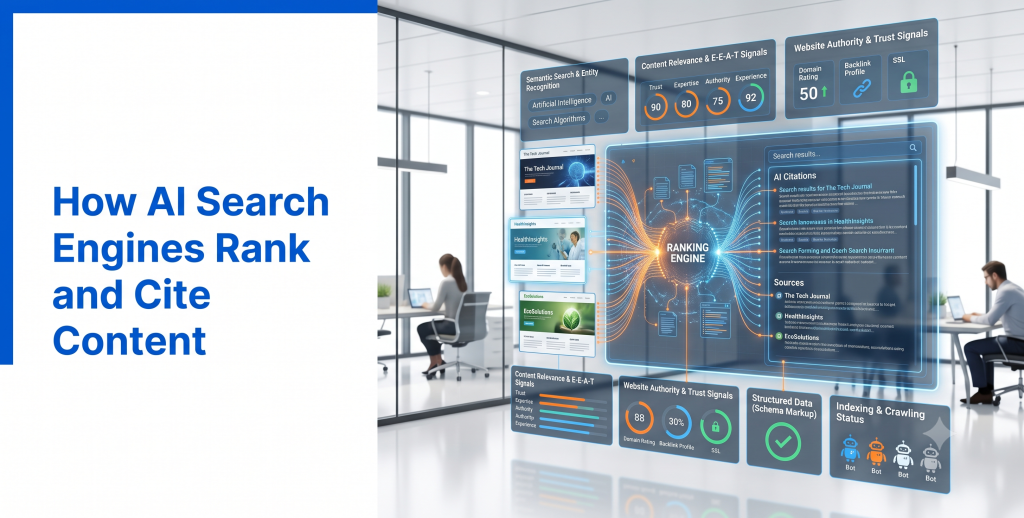
Ever wondered why ChatGPT mentions one brand and not another? Or why Google’s AI Overview quotes a specific stat from a specific site? It’s not random. AI search engines follow patterns, and once you understand them, you can actually influence which content gets picked. Let’s pull back the curtain on how AI search engines rank and cite content, and what that means for anyone creating content today. How AI Search Works Traditional search engines crawl the web, index pages, and rank them using algorithms built around hundreds of signals. Users see a list of links and click through to find their answer. AI search engines work differently. Tools like Google AI Overviews, ChatGPT Search, and Perplexity AI use large language models (LLMs) combined with real-time retrieval systems. When you ask a question, the AI searches relevant sources, reads the content, and generates a synthesized answer in natural language. Some tools cite sources directly, showing links alongside the answer. Others, like standard ChatGPT responses, may summarize information without always crediting where it came from. Either way, your content isn’t competing for a ranking position anymore. It’s competing to be the source the AI trusts enough to pull from. Ranking Factors AI Search Engines Consider AI search engines weigh many of the same fundamentals as traditional SEO, plus a few new priorities. Key factors include: Content clarity: Is the answer easy to extract and understand? Factual accuracy: Can the claim be verified elsewhere? Source credibility: Does the site demonstrate real expertise? Freshness: Is the information current and updated? Structure: Are headings, lists, and formatting clear enough to parse quickly? Unlike traditional rankings, which lean heavily on backlinks, AI models place more weight on how clearly and accurately information is presented. Citation Signals Citation signals determine whether an AI tool decides to reference your content directly. AI models tend to favor: Specific, standalone facts and statistics Clear definitions written in plain language Original research or data not found elsewhere Content that directly answers a specific question For example, a sentence like “Remote employees report 22% higher productivity when given flexible hours, according to a 2025 Gallup study” is far more citable than a vague statement like “Many studies show flexible work helps productivity.” The more specific and verifiable your claim, the more likely it gets quoted. Content Quality Quality still rules everything, but AI search defines quality with a slightly sharper lens. High-quality content, in AI search terms, means: Directly answering the user’s question, ideally within the first few sentences Backing claims with real data or firsthand experience Avoiding filler language that adds length without adding value Covering a topic thoroughly, not just skimming the surface Thin, generic content built purely around keyword targets rarely gets cited. AI models can tell the difference between genuinely useful content and content built just to rank. Authority and Trust Authority matters just as much in AI search as it does in traditional SEO, arguably more. AI models tend to trust: Established publications and recognized industry sources Sites with consistent, accurate publishing history Content backed by named experts with real credentials Sources that other credible sites also reference If you’re a smaller site, building topical authority in a specific niche can help you compete, even against larger, more general competitors. Entity Recognition Entities are specific people, brands, products, or concepts that AI models recognize and connect across different sources. Strong entity signals include: Consistent naming of your brand and key terms across your website Clear connections between your content and recognized industry topics Accurate, consistent business information across platforms like your website and Google Business Profile When AI models clearly understand who you are and what you specialize in, they’re more likely to associate your brand with relevant queries. Semantic Search Semantic search focuses on meaning and context rather than exact keyword matches. AI models understand relationships between concepts. A page about “content marketing strategy” doesn’t need to repeat that exact phrase constantly. It should naturally cover related ideas like audience research, content calendars, distribution channels, and performance tracking. Write content the way you’d naturally explain a topic to someone. Thorough, contextual coverage helps AI models recognize your content as a comprehensive resource, not just a keyword-stuffed page. Structured Data Structured data, or schema markup, helps AI systems interpret your content accurately and efficiently. Useful schema types include: FAQ schema for question-and-answer content Article schema for blog posts Organization schema for business information Product schema for e-commerce listings While structured data doesn’t guarantee citations, it removes ambiguity, making it easier for AI tools to correctly understand and use your content. Internal Linking A well-linked site helps AI crawlers and search engines understand how your content connects and where your expertise lies. Best practices include: Linking naturally to related, relevant content Using descriptive anchor text instead of generic phrases Connecting supporting articles back to your core, comprehensive resources Avoiding orphan pages with no internal links pointing to them This structure signals depth, which helps establish topical authority. EEAT Importance Experience, Expertise, Authoritativeness, and Trustworthiness directly influence whether AI models see your content as citation-worthy. To strengthen EEAT signals: Include real author bios with relevant credentials Share original insights, case studies, or firsthand experience Link to credible sources when referencing outside claims Keep information accurate and regularly updated AI models are increasingly built to prioritize content demonstrating genuine expertise over generic, recycled information. Common Ranking Mistakes Avoid these missteps that hurt AI search visibility: Writing vague, unverifiable claims without supporting data Burying direct answers deep within long paragraphs Ignoring structured data and schema markup Publishing without clear authorship or credentials Letting outdated statistics and information sit unchecked Best Practices To improve your chances of ranking and citation in AI search: Lead with clear, direct answers Use specific data and real examples Structure content with clear headings and short paragraphs Add relevant structured data Build genuine topical authority through consistent, accurate publishing Update content regularly to maintain accuracy Future AI Ranking Signals AI search ranking signals are still evolving,

GEO (Generative Engine Optimization)

The Ultimate GEO Checklist

You’ve read about what GEO is. You know how it differs from SEO. Now comes the part that actually moves the needle: doing the work. This checklist pulls everything together into one practical resource. No fluff, no theory, just a clear list you can run through page by page. Bookmark this one. You’ll want to come back to it. Why GEO Matters AI search tools like ChatGPT, Google AI Overviews, and Perplexity now answer millions of questions every day without sending a single click to a website. If your content isn’t structured for these tools, you’re invisible in a growing part of the search landscape, even if you rank well on Google. GEO isn’t optional anymore. It’s the checklist that keeps you visible no matter how someone searches. Content Checklist Start here, because content is the foundation everything else builds on. Answer the main question in the first 1-2 sentences of each section Use short paragraphs (2-4 sentences max) Include specific numbers, data, or examples instead of vague claims Write in plain, conversational language Cover related subtopics naturally, not just the exact keyword Update outdated stats and information regularly Avoid filler intros that delay the actual answer Example: Instead of writing “There are many factors that affect page speed,” write “Page speed depends mainly on image size, server response time, and code efficiency.” Technical SEO Checklist AI tools still need to crawl and read your site efficiently. Fast loading speed (under 3 seconds ideally) Mobile-friendly, responsive design Clean URL structure Working robots.txt that doesn’t block important pages HTTPS security enabled No broken links or 404 errors on key pages XML sitemap submitted and updated EEAT Checklist Experience, Expertise, Authoritativeness, and Trustworthiness matter more in AI search, not less. Real author bios with genuine credentials First-hand experience or original insights included Sources linked for any statistics or claims Contact information and business details clearly visible Reviews, testimonials, or case studies included where relevant Content reviewed or updated on a regular schedule Example: A finance blog post written by a certified financial planner, with their credentials listed, carries far more weight than an unsigned generic article. AI Citation Checklist This is where GEO gets specific. These steps directly influence whether AI tools quote your content. Write clear, standalone sentences that work as direct quotes Include original data or research AI can’t find elsewhere Add FAQ sections that mirror real user questions Define key terms clearly and early Keep facts accurate and easy to verify Avoid burying important information in long paragraphs Example: A sentence like “Email open rates average 21.5% across industries, according to Mailchimp’s 2025 benchmark report” is easy for an AI tool to lift and cite directly. Structured Data Checklist Structured data helps AI systems understand your content without guessing. Article schema on blog posts FAQ schema on question-based sections Product schema on e-commerce pages Organization schema with accurate business details Breadcrumb schema for site navigation Validated markup with no errors Internal Linking Checklist A well-connected site shows both users and AI models that you cover a topic in depth. Link to related articles naturally within content Use descriptive anchor text, not “click here” Link cornerstone content from multiple relevant pages Avoid orphan pages with no internal links pointing to them Keep navigation simple and logical Semantic SEO Checklist Semantic SEO focuses on meaning and context, not just repeated keywords. Cover related concepts and subtopics thoroughly Use natural variations of your target keyword Avoid forced or repetitive keyword placement Structure headings around real user questions Write the way you’d naturally explain the topic out loud Performance Checklist Ongoing performance tracking keeps your GEO strategy sharp. Monitor organic traffic and rankings monthly Track brand mentions inside AI tools by testing relevant queries Review Google Search Console for indexing issues Check Core Web Vitals regularly Audit top-performing pages for GEO improvements Common Mistakes Even experienced marketers slip up here. Watch for these: Treating GEO as a one-time project instead of an ongoing habit Keyword stuffing content in an attempt to “optimize” it Ignoring structured data entirely Publishing content without clear author credentials Letting outdated statistics sit unchecked for years Focusing only on rankings while ignoring AI visibility Final GEO Audit Checklist Before publishing or updating any page, run through this quick final pass: Does the content answer the main question clearly and early? Is the structure scannable, with short paragraphs and clear headings? Are claims backed by real data or experience? Is structured data added and validated? Are internal links relevant and natural? Is the page technically sound and mobile-friendly? Would this content be easy for an AI tool to quote accurately? If you can check every box, your content is in strong shape for both traditional SEO and AI search. Conclusion GEO doesn’t require reinventing your entire strategy. It requires sharpening what already works: clear content, real expertise, solid technical foundations, and structure that makes sense to both humans and machines. Run your next page through this checklist before hitting publish. Small, consistent improvements add up fast, and they’re exactly what keeps you visible as search keeps evolving. FAQs 1. How often should I run through this GEO checklist? Ideally, review new content before publishing and revisit older, high-traffic pages every few months. 2. Do I need to complete every item on this checklist for every page? Not always. Prioritize high-value pages first, then work through the rest over time. 3. Is this checklist only for blog content? No. It applies to product pages, service pages, and any content you want visible in both traditional and AI search. 4. How do I know if my GEO efforts are working? Test relevant questions directly in AI tools and check if your brand or content gets mentioned, alongside monitoring organic traffic trends. 5. Can I use this checklist alongside my existing SEO process? Yes. This checklist is designed to complement, not replace, your current SEO workflow.   Meta Title: Th

GEO (Generative Engine Optimization)

How to Optimize Your Website for AI Search

A few years ago, “getting found online” meant one thing: ranking on Google’s first page. Today, it means something bigger. Your content also needs to show up inside AI Overviews, ChatGPT answers, and Perplexity summaries. If you’re only optimizing for traditional rankings, you’re missing half the picture. Here’s how to actually optimize your website for AI search, step by step, with practical changes you can start making today. Understanding AI Search AI search tools like Google AI Overviews, ChatGPT, Perplexity, and Copilot don’t just crawl and rank pages. They read content, extract facts, and generate a direct answer for the user. Instead of showing ten blue links, these tools summarize information from multiple sources into one conversational response. Sometimes they cite the original sources. Sometimes they don’t. This means your content has a new job. It’s not just competing for a ranking spot anymore. It’s competing to be the source an AI model trusts enough to quote. How AI Search Differs from Traditional Search Traditional search engines rank pages using signals like keywords, backlinks, and site authority, then display a results list. Users click through to find their answer. AI search skips that step. It reads across many sources, synthesizes the information, and delivers the answer directly. The user might never click anything at all. This changes what “ranking” even means. Instead of asking “does my page appear on page one,” the real question becomes “does my content get pulled into the answer.” That shift is exactly why AI search optimization requires new thinking, not a complete overhaul, but a real shift in priorities. Website Structure for AI Search AI models favor content that’s easy to parse. That starts with structure. Use clear, descriptive headings (H1, H2, H3) that reflect how people actually phrase questions. Instead of a vague heading like “Our Process,” try “How Does Our Onboarding Process Work?” Break content into scannable sections. Long, dense blocks of text are harder for AI models to extract clean facts from. Short paragraphs, bullet points, and numbered lists make it much easier for both AI tools and human readers to find what they need. A logical hierarchy matters too. Pages should flow from a clear introduction, into specific sections, ending with practical takeaways, not buried thoughts scattered across a wall of text. Content Optimization AI search rewards content that directly answers a question, ideally within the first few sentences of a section. If someone asks “What is the best time to post on Instagram,” don’t bury the answer three paragraphs deep. Lead with it, then explain the reasoning afterward. Other content habits that help: Answer one clear question per section. Use specific numbers, data, and examples instead of vague claims. Avoid filler phrases that add length without adding value. Write like you’re explaining something to a smart friend, not writing a legal document. Semantic SEO Semantic SEO means optimizing for meaning and context, not just exact keyword matches. AI models understand relationships between concepts. A page about “email marketing tips” doesn’t need to repeat that exact phrase twenty times. It needs to naturally cover related ideas: subject lines, open rates, segmentation, automation, and deliverability. Write content the way you’d naturally talk about a topic. Cover it thoroughly, use related terms organically, and trust that AI models are smart enough to connect the dots. Entity Optimization Entities are specific people, places, brands, or concepts that search engines and AI models recognize and connect across the web. To strengthen entity signals: Use consistent naming for your brand, products, and key terms across your site. Link to authoritative sources when referencing outside data or concepts. Make sure your business information (name, address, industry) is consistent across your website, Google Business Profile, and other platforms. Strong entity signals help AI models understand exactly who you are and what you’re an authority on. Structured Data Structured data, or schema markup, helps AI tools and search engines understand your content’s context instantly, instead of guessing. Useful schema types include: Article schema for blog posts. FAQ schema for question-and-answer sections. Product schema for e-commerce pages. Organization schema for business details. Adding structured data doesn’t guarantee AI citations, but it removes friction, making it easier for these systems to accurately interpret your content. EEAT Signals EEAT stands for Experience, Expertise, Authoritativeness, and Trustworthiness. It matters just as much for AI search as it does for traditional SEO, arguably more. To strengthen EEAT: Include real author bios with genuine credentials. Share firsthand experience, case studies, or original data when possible. Link to credible sources to back up claims. Keep information accurate and updated regularly. AI models are increasingly built to favor content that demonstrates real expertise over generic, recycled information. Internal Linking Internal links help AI crawlers and search engines understand how your content connects. A well-linked site signals depth and topical authority. Link naturally between related articles. If you’re writing about “GEO best practices,” link to your related piece on “SEO vs GEO” or “AI search engines.” This builds a content web that shows both users and AI models that you cover a topic thoroughly. Technical SEO for AI AI tools still need to access your site to read it, so technical fundamentals remain critical. Focus on: Fast page load speeds. Mobile-friendly design. Clean, crawlable site architecture. Proper use of robots.txt, making sure important pages aren’t accidentally blocked. HTTPS security. If AI crawlers can’t access or read your site efficiently, none of your content optimization matters. AI Citation Optimization To increase your odds of being cited directly: Write in a clear, quotable style, almost like you’re writing a definition or direct answer. Include original statistics, research, or insights AI models can’t find anywhere else. Keep facts accurate and easy to verify. Use FAQ sections that mirror real user questions. The easier it is to lift a clean, accurate sentence from your content, the more likely an AI tool is to use it. Common Mistakes Avoid these common missteps: Keyword stuffing. It hurts AI search just as much as

GEO (Generative Engine Optimization)

GEO vs SEO: What’s the Difference?

Type a question into Google today, and there’s a good chance you’ll see an AI-generated answer before you see a single blue link. Ask that same question to ChatGPT, and you’ll get a conversational response with no links at all, just an answer. This shift has marketers asking a new question: is SEO still enough, or do we need something else entirely? The answer is GEO, Generative Engine Optimization. But GEO isn’t here to replace SEO. It’s here to work alongside it. Let’s break down exactly how these two strategies differ, where they overlap, and how to use both effectively. What Is SEO? Search Engine Optimization (SEO) is the practice of improving a website so it ranks higher in traditional search engine results, primarily Google and Bing. SEO has been around since the late 1990s, and it’s built on a few core pillars: Keywords: Using the terms people actually search for. Backlinks: Earning links from other trustworthy sites. Technical health: Fast load times, mobile-friendliness, clean site structure. On-page optimization: Title tags, meta descriptions, header structure, and internal linking. The goal of SEO is simple: rank as high as possible so users click through to your website. If you’ve ever searched “best running shoes for flat feet” and clicked the third result because it looked trustworthy, you’ve experienced SEO doing its job. What Is GEO? Generative Engine Optimization (GEO) is the practice of optimizing content so AI tools like ChatGPT, Google AI Overviews, Perplexity, and Copilot cite, summarize, or reference it when generating answers. Instead of aiming for a ranking position, GEO aims for something different: getting mentioned inside the answer itself. Here’s a real-world example. Someone asks ChatGPT, “What’s the best CRM for small teams?” The AI doesn’t return a list of ten links. It generates a direct answer, maybe naming three tools, describing their strengths, and possibly linking to one or two sources. If your blog post about CRMs gets pulled into that answer, that’s GEO working. GEO relies on large language models (LLMs) that read and synthesize information from across the web, then generate natural-language responses. Getting cited requires different signals than getting ranked. Key Differences Between GEO and SEO The core difference comes down to this: SEO optimizes for placement, GEO optimizes for inclusion. A few more differences worth understanding: Output format. SEO produces a list of links. GEO produces a single synthesized answer, sometimes with citations, sometimes without. Success metrics. SEO success is measured by rankings, organic traffic, and click-through rates. GEO success is measured by citation frequency, brand mentions in AI answers, and share of voice inside generated responses. Content style. SEO rewards keyword-optimized, structured pages built around search intent. GEO rewards clear, fact-dense, directly answerable content that reads naturally, almost like it’s already written to be quoted. User journey. SEO assumes the user will click through to your site. GEO assumes the user may never visit your site at all, they just see your brand mentioned inside the AI’s answer. Ranking factors. SEO leans heavily on backlinks and domain authority. GEO leans more on originality, factual accuracy, and how well your content demonstrates real expertise. Comparison Table Factor SEO GEO Goal Rank high in search results Get cited in AI-generated answers Primary platforms Google, Bing ChatGPT, AI Overviews, Perplexity, Copilot Success metric Rankings, organic traffic Citations, brand mentions Content style Keyword-optimized pages Clear, fact-based, quotable content User outcome Click to website May never click, just sees the answer Key ranking signals Backlinks, keywords, technical SEO Accuracy, clarity, structured data, expertise Age of practice 25+ years Emerging since 2023-2024 Similarities Between GEO and SEO Despite their differences, GEO and SEO share real common ground. Both reward high-quality, trustworthy content. Both benefit from clear structure, useful headings, and content that actually answers the user’s question. Both depend on technical basics like crawlability, since AI tools still need to access and read your site. And both are ultimately about the same thing: being useful enough that a system, whether it’s a search algorithm or a language model, decides you’re worth surfacing. When to Use SEO SEO still matters, and it’s not going anywhere. Lean on SEO when: You want direct website traffic and conversions. You’re running an e-commerce site where clicks lead to sales. Local search matters, like “plumber near me” searches. You’re building long-term domain authority and backlinks. If your business depends on people landing on your site to book, buy, or sign up, SEO remains essential. When to Focus on GEO GEO becomes especially important when: Your audience uses AI tools for research or recommendations. You’re in a competitive niche where AI Overviews dominate the search results. Brand visibility and authority matter more than immediate clicks. You want to build trust before a user ever reaches your website. If you’re a B2B company, a niche expert, or a thought leader, GEO can help you stay visible even when users skip traditional search entirely. Can GEO and SEO Work Together? Absolutely, and honestly, they work best together. Strong SEO fundamentals, like technical performance, clear structure, and authoritative content, form the foundation GEO builds on. AI models still crawl the web, and many still rely partly on search engine indexes to retrieve information. A well-optimized SEO page with clear headings, strong data, and demonstrated expertise is far more likely to get pulled into an AI answer than a poorly structured page, even if that page ranks well. Think of SEO as the infrastructure and GEO as the amplifier sitting on top of it. Best Practices for Both To cover your bases across both strategies: Write clear, direct answers near the top of your content. Use descriptive headings that match real user questions. Back up claims with data, statistics, or firsthand experience. Keep technical SEO solid: fast pages, mobile-friendly design, clean structure. Add structured data and schema markup where relevant. Build genuine backlinks and citations from credible sources. Update content regularly so it stays accurate and current. The Future of Search Optimization Search is splitting into two

GEO (Generative Engine Optimization)

What Is Generative Engine Optimization (GEO)?

Search is changing faster than most marketers can keep up with. If you’ve noticed AI-generated answers showing up above the usual blue links on Google, or you’ve started asking ChatGPT questions you used to type into a search bar, you’ve already met the reason GEO exists. Generative Engine Optimization is the new discipline built for this shift. It’s not a replacement for SEO, but it’s quickly becoming just as important. Let’s break down what it actually means and why it matters right now. What Is GEO? Generative Engine Optimization (GEO) is the practice of optimizing content so it gets picked up, cited, and recommended by AI-powered search tools like ChatGPT, Google’s AI Overviews, Perplexity, and Microsoft Copilot. Traditional SEO focuses on ranking a page in a list of links. GEO focuses on something different: getting your brand, product, or ideas mentioned inside an AI-generated answer. Think of it this way. SEO gets you a seat at the table. GEO gets you quoted in the conversation. These AI tools run on large language models (LLMs) trained on massive amounts of text. When someone asks a question, the AI doesn’t just list websites. It reads, synthesizes, and generates a direct answer, often pulling facts, phrases, and sources from content across the web. GEO is about making sure your content is the kind of content these systems want to pull from. Why GEO Matters in 2026 AI search isn’t a side trend anymore. It’s a daily habit for millions of people. More users are skipping traditional search results entirely and going straight to AI chat tools for research, recommendations, and quick answers. Even inside Google, AI Overviews now appear for a huge share of searches, often sitting above every organic listing. This means a page can rank on page one and still get zero clicks, because the AI already answered the question before the user scrolled down. For businesses, this is a real visibility problem. If your content isn’t structured in a way AI models can understand and trust, you simply won’t show up in the answer, no matter how good your traditional rankings are. How GEO Works GEO works by making your content easier for AI models to read, extract, and trust. Here’s the general process: AI tools crawl and index content, similar to search engines, but they also rely on training data and real-time retrieval. When a user asks a question, the model identifies relevant sources. It pulls facts, statistics, and phrasing it judges as clear, credible, and well-structured. It generates a natural-language answer, sometimes citing sources directly. Content that’s well-organized, fact-based, and easy to quote has a much better shot at being selected. Vague, fluffy, or poorly structured content usually gets skipped. GEO vs Traditional SEO GEO and SEO share a lot of DNA, but they’re not identical. SEO focuses on keywords, backlinks, and ranking positions. GEO focuses on clarity, citations, and being the source an AI trusts enough to quote. SEO measures success through clicks and rankings. GEO measures success through visibility inside AI answers, even if that never results in a direct click. The good news? A strong SEO foundation still matters. GEO builds on top of it rather than replacing it. Benefits of GEO Optimizing for AI search comes with real, practical advantages: Earlier visibility. Your brand can appear in the AI answer before the user even sees a list of websites. Authority building. Being cited by AI tools signals trust to both users and search engines. Future-proofing. As AI search grows, early adopters gain a lasting edge. Better content quality. GEO pushes you to write clearer, more useful, fact-based content, which helps human readers too. Key Ranking Factors for GEO While GEO is still evolving, a few factors consistently influence whether AI tools cite your content: Clarity and structure. Short paragraphs, clear headings, and direct answers perform better. Factual accuracy. AI models favor content with verifiable data, statistics, and specific details. Author expertise. Bylines, credentials, and demonstrated experience boost trust. Original insight. Generic rehashed content gets ignored in favor of unique perspectives. Structured data. Schema markup helps AI systems understand context faster. Natural language formatting. Content written to directly answer questions, almost like an FAQ, tends to get quoted more often. Common GEO Myths Myth 1: GEO replaces SEO. Not true. GEO builds on SEO fundamentals like site speed, mobile-friendliness, and quality backlinks. Myth 2: Keyword stuffing helps GEO. It doesn’t. AI models penalize unnatural, repetitive phrasing just as much as search engines do. Myth 3: Only big brands get cited. AI tools care more about clarity and accuracy than brand size. Small sites with specific, well-organized expertise often get quoted over generic corporate content. Myth 4: GEO is a short-term trend. Given how fast AI search adoption is growing, GEO looks more like a permanent shift than a passing phase. GEO Best Practices If you want to start optimizing today, focus on these habits: Answer questions directly and early in your content. Use clear headings that match how people actually ask questions. Back up claims with real data, studies, or firsthand experience. Keep paragraphs short and scannable. Add author bios that show genuine expertise. Use structured data markup where possible. Update content regularly to keep facts current. The Future of GEO GEO is still young, but it’s moving fast. Expect AI search tools to get better at verifying sources, favoring original research, and rewarding sites that consistently produce trustworthy content. Voice search, AI browsing assistants, and multimodal search will likely deepen this shift further. The brands that treat GEO as a core strategy now, not an afterthought, will have a real head start. Conclusion Generative Engine Optimization is the natural next step for anyone serious about visibility in an AI-driven search world. It doesn’t throw out everything you know about SEO. It builds on it, with a sharper focus on clarity, trust, and being the source AI tools actually want to quote. Start small. Tighten your structure, back up your claims, and write like

Scroll to Top