How to Create Content That Converts Visitors Into Customers
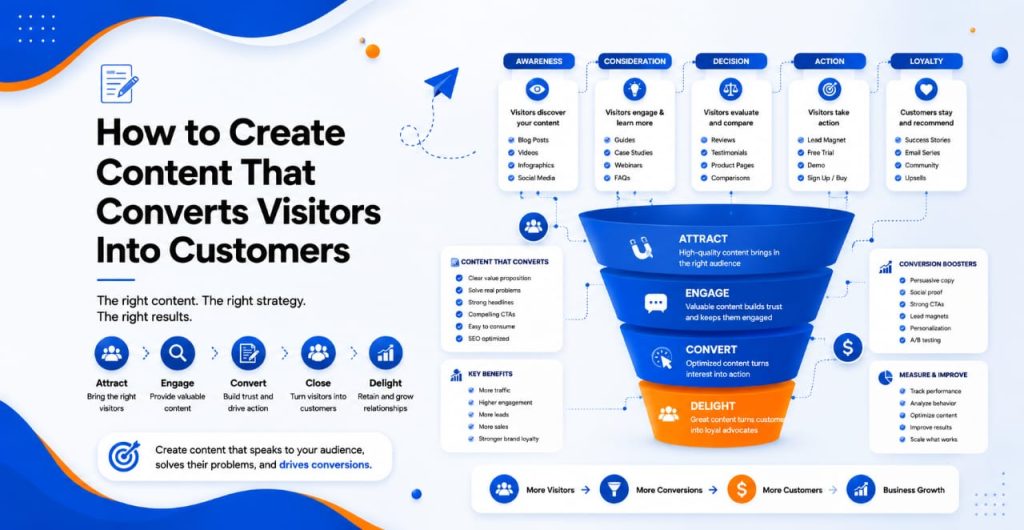
Introduction Did you know that most websites convert less than three percent of their visitors into paying customers? Traffic alone will not grow your business. Without strategic, conversion-focused content, even thousands of monthly visitors can leave without taking action. Learning how to create content that converts visitors into customers means understanding your audience, matching their intent, and guiding them confidently through the buyer journey. This guide breaks down exactly how to do that, step by step, with practical examples you can apply immediately What Is Conversion-Focused Content? Conversion-focused content is writing designed with a clear business goal in mind, whether that is a purchase, a signup, or a booked call. Unlike purely informative content, it blends education with persuasion. This distinction matters because informative content builds awareness, while conversion-focused content moves readers toward a decision. Businesses that combine both create a content funnel that nurtures leads from first click to final sale. Content Type Primary Goal Example Informative Content Educate and build awareness Blog post explaining a concept Conversion-Focused Content Drive a specific action Landing page with a clear CTA Trust-Building Content Reduce buyer hesitation Case study or testimonial page How to Create Content That Converts Visitors Into Customers The following ten strategies form a proven content marketing strategy for turning casual browsers into loyal, paying customers. 1. Understand Your Target Audience You cannot convert someone you do not understand. Build clear buyer personas that outline your audience’s goals, pain points, and objections before writing a single word. Example: A SaaS company selling project management software might discover its main users are overwhelmed team leads, not executives, and adjust its messaging accordingly. 2. Match Content to Search Intent Google rewards content that satisfies the intent behind a query, whether that intent is informational, navigational, or transactional. Example: An eCommerce brand ranking for “best running shoes for flat feet” should write a buying guide, not a generic product description. 3. Write Compelling Headlines Your headline determines whether visitors stay or leave. Strong headlines promise a clear benefit and spark curiosity. Example: Changing “Our Services” to “How Our Software Cuts Onboarding Time by 40%” immediately signals value. 4. Focus on Solving Customer Problems Every section of your content should answer a real question or resolve a real frustration your prospect has. Example: A digital agency blog that walks readers through fixing slow page speed builds authority while naturally showcasing expertise. 5. Build Trust with Social Proof and Case Studies Testimonials, reviews, and data-backed case studies reduce the perceived risk of taking action. Example: A startup adding “Trusted by 500+ small businesses” beside a client logo bar often sees stronger form completions. 6. Use Clear and Persuasive Calls-to-Action (CTAs) A strong call-to-action tells visitors exactly what to do next and why it benefits them. Example: Replacing “Submit” with “Get My Free Audit” consistently improves click-through rates. 7. Optimize Content for SEO and Readability Content must be discoverable and easy to scan, with clear headings, short paragraphs, and natural keyword placement. Example: A blog broken into scannable subheadings keeps mobile readers engaged far longer than dense text blocks. 8. Use Visuals to Improve Engagement Images, charts, and short videos break up text and help explain complex ideas quickly. Example: A comparison chart on a pricing page often reduces support questions and speeds up decisions. 9. Create High-Converting Landing Pages Landing pages should have one focused goal, minimal distractions, and a benefit-driven headline supported by proof. Example: Removing extra navigation links from a signup page can meaningfully increase completed registrations. 10. Measure, Test, and Improve Performance Conversion optimization is ongoing. Use analytics and A/B testing to refine headlines, CTAs, and layouts over time. Example: A marketing team testing two CTA colors might find one variant consistently outperforms the other. Common Mistakes That Reduce Content Conversions Writing only for search engines instead of real readers Weak or missing calls-to-action Ignoring user intent behind key search terms Poor website navigation that hides next steps Long, unreadable paragraphs that overwhelm visitors Lack of trust signals like reviews or case studies No performance tracking to guide improvements Best Tools for Creating High-Converting Content The right tools make it easier to research, write, and optimize content that performs. Tool Purpose Best For Google Analytics Tracks visitor behavior and conversion paths Measuring which content drives sales Google Search Console Monitors search performance and indexing Improving organic visibility Ahrefs Keyword research and backlink analysis Competitive SEO strategy SEMrush All-in-one SEO and content auditing Content gap analysis Grammarly Grammar and readability checking Polishing conversion copy Canva Visual and graphic design Creating engaging visuals Hotjar Heatmaps and session recordings Understanding user behavior HubSpot CRM and marketing automation Managing leads and CTAs Best Practices for Conversion-Focused Content Marketing Know your audience deeply before writing Prioritize user experience across every page Write benefit-driven copy, not just features Use strong, specific CTAs throughout your funnel Add testimonials and reviews for social proof Optimize every page for mobile devices Improve page speed to reduce bounce rate Update content regularly to stay accurate and ranked A/B test headlines and CTAs to find what works Key Takeaways Traffic without conversion-focused content rarely turns into revenue. Understanding audience intent is the foundation of high-converting content. Strong headlines and CTAs directly influence conversion rate optimization. Social proof reduces hesitation and builds buyer confidence. SEO and readability work together to keep visitors engaged. Landing pages should have one clear, focused goal. Continuous testing and measurement drive long-term improvement. Conclusion Learning how to create content that converts visitors into customers is not about tricks or shortcuts. It is about combining SEO, genuine value, trust-building, and compelling CTAs into a seamless customer journey. When every page on your site is built with the reader’s needs and your business goals in mind, visitors naturally become customers, and customers become long-term advocates for your brand. Take a moment to audit your existing content today. Identify weak CTAs, outdated pages, and missed opportunities, then start optimizing for conversions one page at a time. Frequently Asked Questions (FAQ)