
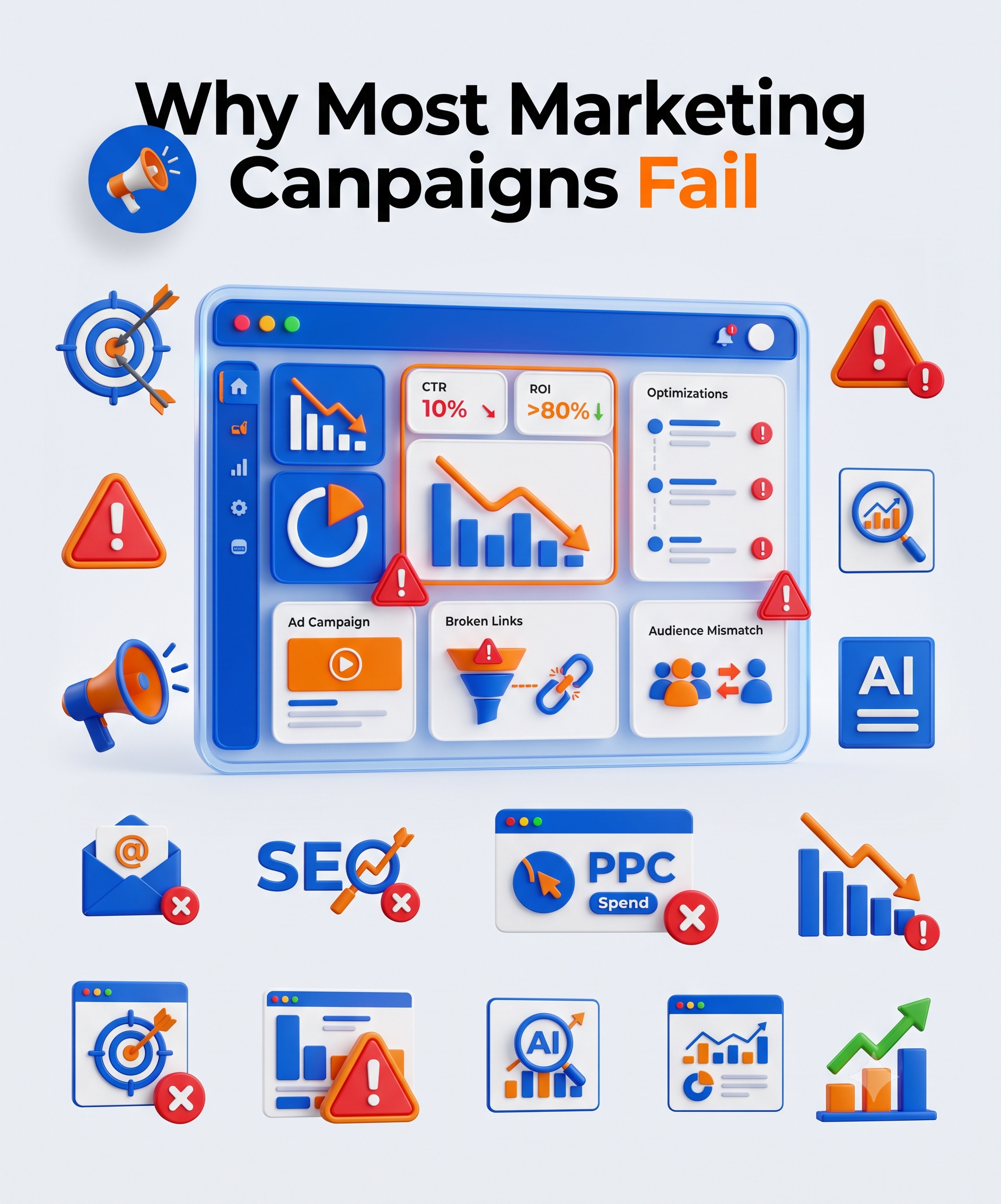
A client once told me she’d spent her entire quarterly budget on a campaign that generated exactly four leads. Four. The ads looked polished. The offer seemed solid. On paper, everything should have worked.
It didn’t, and it’s not because marketing is unpredictable magic. It’s because most campaigns fail for the same handful of reasons, over and over, regardless of industry or budget size.
This article breaks down exactly why most marketing campaigns fail, and more importantly, what separates the campaigns that actually deliver results from the ones that quietly drain budgets.
What Makes a Marketing Campaign Successful?
Before looking at failure, it helps to define success clearly. A successful marketing campaign does three things:
- Reaches the right audience with a message that resonates
- Guides that audience toward a clear, specific action
- Delivers a measurable return that justifies the spend
Notice what’s missing from that list: fancy visuals, viral moments, or clever taglines. Those things help, but they’re not the foundation. Strategy is the foundation.
Top Reasons Marketing Campaigns Fail
Most campaign failures trace back to a mix of unclear planning, weak execution, and poor follow-through. Let’s go through each one in detail.
Lack of Clear Goals
“We want more sales” isn’t a goal. It’s a wish.
A real goal looks like: “Generate 50 qualified leads for our SaaS trial within 60 days at a cost per lead under $40.” That’s specific, measurable, and time-bound.
Without a clear goal, you can’t judge whether a campaign worked. You just feel vaguely good or vaguely disappointed, with no data to back either feeling up.
Fix: Set one primary goal per campaign, along with a specific number and timeframe attached to it.
Poor Audience Research
Marketing to “everyone” means marketing to no one effectively.
I’ve seen local service businesses run ads targeting an entire city when their actual customers lived within a five-mile radius of specific neighborhoods. The budget got spread thin across people who were never going to convert.
Fix: Build a real customer profile — age range, location, pain points, buying behavior — before writing a single line of ad copy.
Weak Value Proposition
If your ad doesn’t answer “why should I choose you instead of the next option,” it won’t convert, no matter how much you spend boosting it.
A gym that advertises “Join today!” says nothing. A gym that advertises “Lose 10 pounds in 8 weeks with a personal trainer, no long-term contract” gives people a reason to click.
Wrong Marketing Channels
Not every channel fits every business. A B2B software company chasing leads on Instagram often wastes budget that would perform far better on LinkedIn or through targeted search ads.
| Business Type | Often Strong Channels | Often Weak Channels |
|---|---|---|
| B2B SaaS | LinkedIn, Google Ads, Email | TikTok, Pinterest |
| Local Service | Google Business Profile, Facebook | |
| E-commerce | Instagram, Facebook Ads, Google Shopping | |
| B2B Consulting | LinkedIn, Email, Referrals | TikTok |
Poor Landing Pages
Driving traffic to a cluttered homepage instead of a focused landing page is one of the most common digital marketing failures I see.
A landing page needs one job: convert visitors for one specific offer. Multiple competing calls-to-action confuse people, and confused visitors leave.
Weak Content Strategy
Publishing content inconsistently, or without any connection to what your audience actually searches for, wastes time and rarely builds momentum.
Fix: Build content around real customer questions, then publish consistently rather than in bursts followed by long silence.
Ignoring SEO
Paid ads stop working the moment you stop paying. SEO keeps working long after the initial effort, which makes ignoring it one of the costliest marketing strategy mistakes a business can make.
Even a handful of well-optimized pages targeting specific search terms can outperform months of paid campaigns in long-term value.
Poor Ad Targeting
Broad targeting feels safer, but it usually burns budget fast. Narrow, intent-based targeting almost always outperforms casting a wide net.
Fix: Layer targeting by demographics, interests, and behavior, then refine based on which segments actually convert.
Low-Quality Creatives
Blurry images, generic stock photos, and copy that reads like a corporate memo all quietly kill conversion rates.
People respond to creatives that feel authentic. A short, slightly imperfect video of a real product in use often outperforms a polished but generic studio shot.
Lack of Personalization
Sending the same message to every lead, regardless of where they are in the buying journey, is a fast way to lose interest.
A first-time website visitor and a returning customer who abandoned their cart need completely different messages.
No Marketing Automation
Manually managing follow-ups doesn’t scale. Without automation, leads slip through the cracks simply because no one remembered to follow up in time.
Fix: Set up automated sequences triggered by specific actions, like a form submission or a pricing page visit.
Poor Follow-Up Process
Studies on sales response times consistently show that faster follow-up significantly increases conversion likelihood. Yet many businesses take days to respond to a new lead.
Fix: Aim to make first contact within minutes to hours, not days, especially for high-intent leads.
Weak Lead Nurturing
Not every lead is ready to buy immediately. Without a nurturing sequence, many simply forget about you and move on to a competitor who stayed in touch.
Budget Mismanagement
Spending the entire budget upfront, without testing first, is one of the most common advertising mistakes small businesses make.
Fix: Start with a smaller test budget, identify what performs, then scale spend into the winning campaigns.
No A/B Testing
Guessing which headline or image performs better wastes money. Testing removes the guesswork.
Even simple tests — one headline against another — often reveal surprising differences in performance that pure intuition would never predict.
Ignoring Analytics
Running a campaign without checking analytics is like driving with your eyes closed. You might get lucky, but you won’t know why, and you can’t repeat it.
Tracking the Wrong KPIs
Likes and impressions feel satisfying, but they rarely pay the bills. Focus on metrics tied directly to revenue and lead quality instead.
| Vanity Metric | Better Metric to Track |
|---|---|
| Likes | Click-through rate |
| Impressions | Cost per lead |
| Followers | Conversion rate |
| Shares | Customer lifetime value |
Failure to Optimize Campaigns
Launching a campaign and never touching it again is a guaranteed way to underperform. The best-performing campaigns get reviewed and adjusted regularly based on real data.
Mobile Experience Issues
Most traffic today comes from mobile devices. A campaign that looks great on desktop but breaks on mobile loses a huge share of potential customers before they even see your offer clearly.
Slow Website Performance
Every extra second a page takes to load increases the chance a visitor leaves before converting. Speed isn’t a nice-to-have; it’s part of campaign performance.
Poor Customer Experience
A great ad can bring someone to your site, but a confusing checkout process or unhelpful customer service can undo all that work instantly.
Case Study Example
Consider a hypothetical mid-sized furniture retailer that launched a national ad campaign with a strong budget and attractive visuals. Despite the investment, sales barely moved.
After reviewing the campaign, a few issues stood out:
- Ads targeted the entire country instead of areas near actual store locations
- The landing page linked directly to a cluttered homepage
- No follow-up email sequence existed for visitors who browsed but didn’t buy
Once the team narrowed targeting to relevant regions, built a dedicated landing page, and added a simple three-email follow-up sequence, conversion rates improved substantially within weeks. Nothing about the product changed — only the strategy around it did.
How Successful Brands Avoid These Mistakes
Brands that consistently see strong marketing ROI tend to share a few habits:
- They set specific, measurable goals before launching anything
- They test small before scaling spend
- They review analytics weekly, not just at the end of a campaign
- They treat follow-up and nurturing as seriously as the initial ad spend
- They stay willing to kill underperforming campaigns quickly, without ego
Future Marketing Trends for 2026
AI-assisted personalization will keep making it easier to tailor messaging to individual behavior, rather than broad audience segments. First-party data will matter more as privacy regulations tighten and third-party tracking continues shrinking. And campaigns that blend organic content with paid promotion will likely outperform pure ad spend, since audiences increasingly trust content that feels earned rather than bought.
Conclusion
Most marketing campaigns don’t fail because of bad luck or an unpredictable market. They fail because of avoidable mistakes: unclear goals, weak targeting, poor follow-up, and a lack of ongoing optimization.
The businesses that succeed aren’t necessarily the ones with the biggest budgets. They’re the ones that plan carefully, test before scaling, and pay attention to what the data actually says.
Call-to-Action
Before you launch your next campaign, run it through the checklist above. If even one box goes unchecked, fix that first — it could be the exact reason your last campaign underperformed.
Frequently Asked Questions
1. What is the most common reason marketing campaigns fail? Unclear goals top the list. Without a specific, measurable target, it’s nearly impossible to plan, execute, or evaluate a campaign properly.
2. How much budget should a small business spend on testing before scaling a campaign? Many marketers start with 10-20% of the total budget for testing, then scale spend once a clear winning variation emerges.
3. Why do landing pages matter so much for campaign success? A dedicated landing page keeps visitors focused on one specific action, while a generic homepage often distracts them with too many options.
4. How often should marketing campaigns be optimized? Reviewing performance weekly allows for timely adjustments, rather than waiting until a campaign ends to discover what went wrong.
5. What KPIs actually matter for marketing ROI? Cost per lead, conversion rate, and customer lifetime value matter far more than vanity metrics like likes or impressions.
6. Can SEO help fix a failing marketing campaign? SEO won’t fix a poorly targeted paid campaign directly, but it builds long-term traffic that reduces overall dependence on paid ads.
7. Is personalization really necessary for small marketing budgets? Yes. Even simple personalization, like segmenting emails by customer stage, often improves results without requiring a large additional budget.