
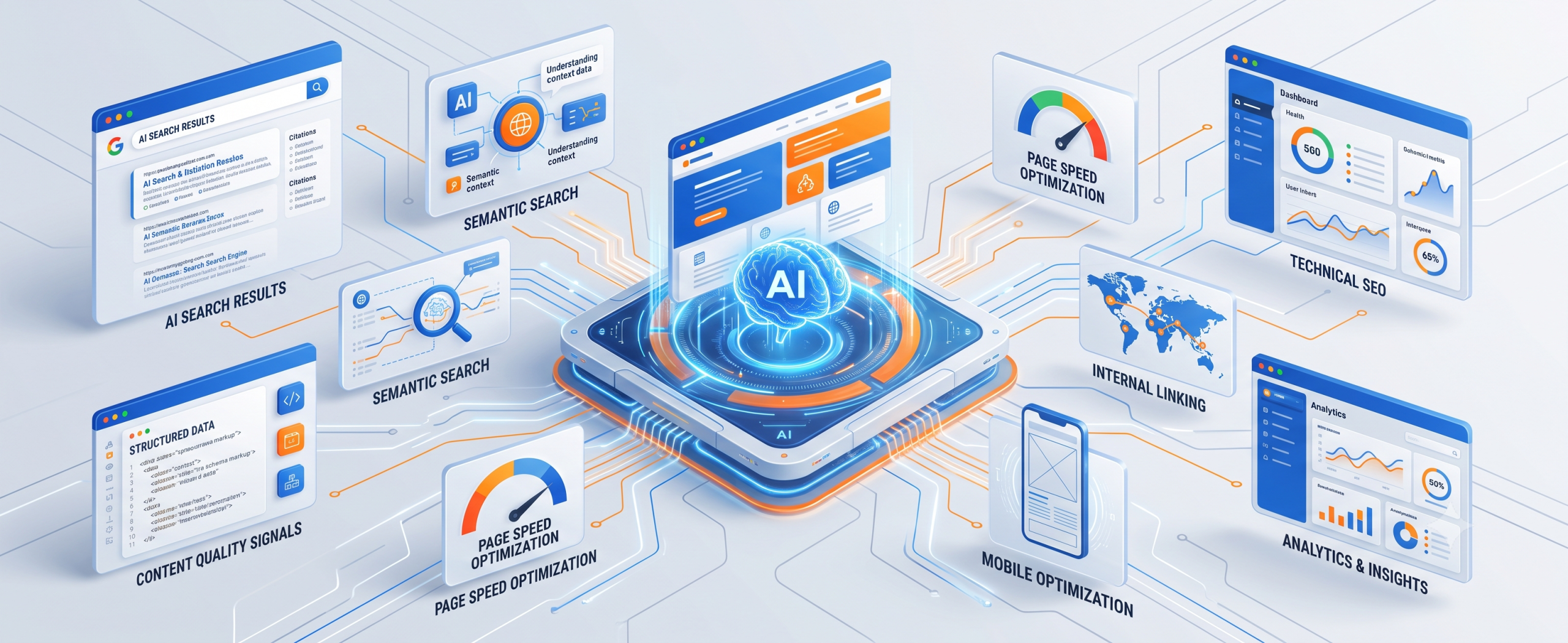
A few years ago, “getting found online” meant one thing: ranking on Google’s first page. Today, it means something bigger. Your content also needs to show up inside AI Overviews, ChatGPT answers, and Perplexity summaries.
If you’re only optimizing for traditional rankings, you’re missing half the picture. Here’s how to actually optimize your website for AI search, step by step, with practical changes you can start making today.
Understanding AI Search
AI search tools like Google AI Overviews, ChatGPT, Perplexity, and Copilot don’t just crawl and rank pages. They read content, extract facts, and generate a direct answer for the user.
Instead of showing ten blue links, these tools summarize information from multiple sources into one conversational response. Sometimes they cite the original sources. Sometimes they don’t.
This means your content has a new job. It’s not just competing for a ranking spot anymore. It’s competing to be the source an AI model trusts enough to quote.
How AI Search Differs from Traditional Search
Traditional search engines rank pages using signals like keywords, backlinks, and site authority, then display a results list. Users click through to find their answer.
AI search skips that step. It reads across many sources, synthesizes the information, and delivers the answer directly. The user might never click anything at all.
This changes what “ranking” even means. Instead of asking “does my page appear on page one,” the real question becomes “does my content get pulled into the answer.”
That shift is exactly why AI search optimization requires new thinking, not a complete overhaul, but a real shift in priorities.
Website Structure for AI Search
AI models favor content that’s easy to parse. That starts with structure.
Use clear, descriptive headings (H1, H2, H3) that reflect how people actually phrase questions. Instead of a vague heading like “Our Process,” try “How Does Our Onboarding Process Work?”
Break content into scannable sections. Long, dense blocks of text are harder for AI models to extract clean facts from. Short paragraphs, bullet points, and numbered lists make it much easier for both AI tools and human readers to find what they need.
A logical hierarchy matters too. Pages should flow from a clear introduction, into specific sections, ending with practical takeaways, not buried thoughts scattered across a wall of text.
Content Optimization
AI search rewards content that directly answers a question, ideally within the first few sentences of a section.
If someone asks “What is the best time to post on Instagram,” don’t bury the answer three paragraphs deep. Lead with it, then explain the reasoning afterward.
Other content habits that help:
- Answer one clear question per section.
- Use specific numbers, data, and examples instead of vague claims.
- Avoid filler phrases that add length without adding value.
- Write like you’re explaining something to a smart friend, not writing a legal document.
Semantic SEO
Semantic SEO means optimizing for meaning and context, not just exact keyword matches.
AI models understand relationships between concepts. A page about “email marketing tips” doesn’t need to repeat that exact phrase twenty times. It needs to naturally cover related ideas: subject lines, open rates, segmentation, automation, and deliverability.
Write content the way you’d naturally talk about a topic. Cover it thoroughly, use related terms organically, and trust that AI models are smart enough to connect the dots.
Entity Optimization
Entities are specific people, places, brands, or concepts that search engines and AI models recognize and connect across the web.
To strengthen entity signals:
- Use consistent naming for your brand, products, and key terms across your site.
- Link to authoritative sources when referencing outside data or concepts.
- Make sure your business information (name, address, industry) is consistent across your website, Google Business Profile, and other platforms.
Strong entity signals help AI models understand exactly who you are and what you’re an authority on.
Structured Data
Structured data, or schema markup, helps AI tools and search engines understand your content’s context instantly, instead of guessing.
Useful schema types include:
- Article schema for blog posts.
- FAQ schema for question-and-answer sections.
- Product schema for e-commerce pages.
- Organization schema for business details.
Adding structured data doesn’t guarantee AI citations, but it removes friction, making it easier for these systems to accurately interpret your content.
EEAT Signals
EEAT stands for Experience, Expertise, Authoritativeness, and Trustworthiness. It matters just as much for AI search as it does for traditional SEO, arguably more.
To strengthen EEAT:
- Include real author bios with genuine credentials.
- Share firsthand experience, case studies, or original data when possible.
- Link to credible sources to back up claims.
- Keep information accurate and updated regularly.
AI models are increasingly built to favor content that demonstrates real expertise over generic, recycled information.
Internal Linking
Internal links help AI crawlers and search engines understand how your content connects. A well-linked site signals depth and topical authority.
Link naturally between related articles. If you’re writing about “GEO best practices,” link to your related piece on “SEO vs GEO” or “AI search engines.” This builds a content web that shows both users and AI models that you cover a topic thoroughly.
Technical SEO for AI
AI tools still need to access your site to read it, so technical fundamentals remain critical.
Focus on:
- Fast page load speeds.
- Mobile-friendly design.
- Clean, crawlable site architecture.
- Proper use of robots.txt, making sure important pages aren’t accidentally blocked.
- HTTPS security.
If AI crawlers can’t access or read your site efficiently, none of your content optimization matters.
AI Citation Optimization
To increase your odds of being cited directly:
- Write in a clear, quotable style, almost like you’re writing a definition or direct answer.
- Include original statistics, research, or insights AI models can’t find anywhere else.
- Keep facts accurate and easy to verify.
- Use FAQ sections that mirror real user questions.
The easier it is to lift a clean, accurate sentence from your content, the more likely an AI tool is to use it.
Common Mistakes
Avoid these common missteps:
- Keyword stuffing. It hurts AI search just as much as traditional SEO.
- Vague, fluffy introductions that delay the actual answer.
- Ignoring structured data entirely.
- Ignoring content freshness, letting outdated stats and information sit unchecked.
- Focusing only on rankings while ignoring how your content performs inside AI-generated answers.
GEO Best Practices
To wrap it all together, here’s a quick GEO checklist:
- Answer questions directly and early.
- Use clear, natural headings.
- Back claims with real data and experience.
- Add structured data where relevant.
- Build strong internal linking.
- Keep technical SEO solid.
- Update content regularly to stay accurate.
Conclusion
Optimizing for AI search isn’t about throwing out everything you know about SEO. It’s about sharpening it. Clear structure, real expertise, and honest, well-organized content matter more than ever.
Start with a few pages, apply these principles, and build from there. The websites that adapt now will be the ones AI tools trust, and cite, well into the future.
FAQs
1. What is AI search optimization? AI search optimization is the process of structuring and writing content so AI-powered tools like ChatGPT and Google AI Overviews can easily read, understand, and cite it.
2. Is AI search optimization the same as GEO? Yes, they’re essentially the same concept. GEO (Generative Engine Optimization) is the formal term for optimizing content for AI-generated search answers.
3. Do I need to rewrite all my old content for AI search? Not necessarily. Start with your highest-traffic or most important pages, then update structure, clarity, and data over time.
4. Does structured data guarantee AI citations? No, but it makes your content easier for AI tools to interpret accurately, which improves your chances.
5. How long does it take to see results from AI search optimization? It varies, but many websites start seeing changes in AI visibility within a few weeks to a few months of consistent optimization.
6. Can small businesses compete in AI search? Yes. AI models often favor clear, accurate, expert content over brand size, giving small businesses a real opportunity to get cited.