Author name: garvita

Lead Generation & Business Growth

Top Digital Marketing Strategies for Small Businesses

If you run a small business, you already know the rules changed. The customer who used to walk past your storefront now scrolls past your Instagram post instead. And in 2026, that scroll happens fast — you get about three seconds to earn attention before someone swipes away. That’s exactly why digital marketing isn’t optional anymore. It’s the new front door to your business. Whether you sell handmade candles, run a local bakery, or offer consulting services, your customers are searching, comparing, and deciding online before they ever pick up the phone. The good news? You don’t need a massive budget or a marketing degree to compete. You need the right strategies, applied consistently. Let’s walk through what actually works. Why Digital Marketing Matters for Small Businesses Big brands have big budgets. Small businesses have something better: agility and authenticity. Digital marketing levels the playing field. A well-optimized Google Business Profile can put your bakery above a national chain in local search results. A genuine, well-written blog post can outrank a corporate page that spent thousands producing generic content. Here’s what digital marketing gives small businesses that traditional advertising never could: Measurable results — you know exactly what’s working Lower costs compared to print, radio, or TV ads Direct access to your ideal customers, not just anyone who happens to see a billboard The ability to build trust before a customer ever contacts you This is the foundation. Everything else builds on it. Build a Fast and SEO-Friendly Website Your website is your digital storefront. If it’s slow, cluttered, or hard to navigate, people leave — often within seconds. What a good small business website needs Load time under 3 seconds (test this with Google PageSpeed Insights) Mobile-friendly design, since most visitors browse on their phones Clear calls-to-action like “Book a Call” or “Get a Quote” Simple navigation — visitors shouldn’t have to hunt for your services or contact info Pro tip: A local plumber I worked with rebuilt his outdated site with faster load times and clear service pages. His phone inquiries doubled within two months, without spending a dollar more on ads. Invest in Local SEO If you serve customers in a specific area, local SEO deserves serious attention. This is how you show up when someone searches “coffee shop near me” or “electrician in [city].” Local SEO basics that actually move the needle Use your city and neighborhood names naturally in website content Build local citations on directories like Yelp and industry-specific sites Keep your name, address, and phone number consistent everywhere online Earn backlinks from local news sites, chambers of commerce, or community blogs Local business marketing isn’t glamorous work, but it’s often the highest-return activity available to a small business. Google Business Profile Optimization Your Google Business Profile is arguably the single most important free marketing tool you have. Steps to optimize it properly Fill out every section completely — hours, categories, services, and attributes Add fresh photos regularly, not just once at setup Post updates and offers through the profile’s post feature Respond to every review, good or bad Choose accurate primary and secondary business categories A fully optimized profile often outperforms paid ads for local visibility, and it costs nothing but time. Content Marketing Strategy Content marketing builds trust over time. It answers the questions your customers are already typing into Google. Think about what your customers ask you in person. Turn those questions into blog posts, guides, or FAQs. A landscaping company might write “How Often Should You Water Your Lawn in Summer?” That single post can bring in traffic for years. Best practice: Publish consistently rather than perfectly. One solid post a week beats ten posts crammed into a single month, then silence for three. Email Marketing Email marketing remains one of the most affordable digital marketing tips available, with returns that consistently outperform social media. How to use it well Send a welcome email immediately after someone subscribes Share useful tips, not just sales pitches Segment your list so loyal customers get different messages than new leads Keep subject lines short and honest — no clickbait A small skincare brand I know sends one helpful tip per week alongside occasional promotions. Their email list now drives nearly 30% of total sales. Social Media Marketing Social media isn’t about being everywhere. It’s about being consistent where your customers actually spend time. A B2B consultant probably belongs on LinkedIn, not TikTok A boutique clothing store likely thrives on Instagram A local service business often does well with Facebook groups and community pages Post behind-the-scenes content, customer stories, and genuine moments. People connect with people, not polished ads. Google Ads Google Ads puts you in front of people actively searching for what you sell. That intent makes it one of the most efficient forms of paid marketing. Pro tip: Start small. Set a modest daily budget, target specific keywords tied to your services, and track which ads actually convert before scaling up spend. Facebook & Instagram Ads While Google Ads captures intent, Facebook and Instagram ads build awareness and re-engage past visitors. Use retargeting ads to reach people who visited your site but didn’t buy Test multiple images or videos to see what resonates Keep ad copy conversational, not corporate A small furniture shop used retargeting ads showing items customers had browsed. Their conversion rate nearly tripled compared to generic ads shown to cold audiences. Video Marketing Video builds trust faster than almost any other content format. You don’t need expensive equipment — a smartphone and good lighting go a long way. Ideas that work well for small businesses: Quick product demonstrations Customer testimonials Behind-the-scenes footage of your process Short educational clips answering common questions AI-Powered Marketing Automation AI tools have made marketing automation accessible to businesses of any size. You can now automate email sequences, chatbot responses, and even ad optimization without hiring a full marketing team. Use AI to save time on repetitive tasks, but keep your brand’s voice human.
Content Marketing

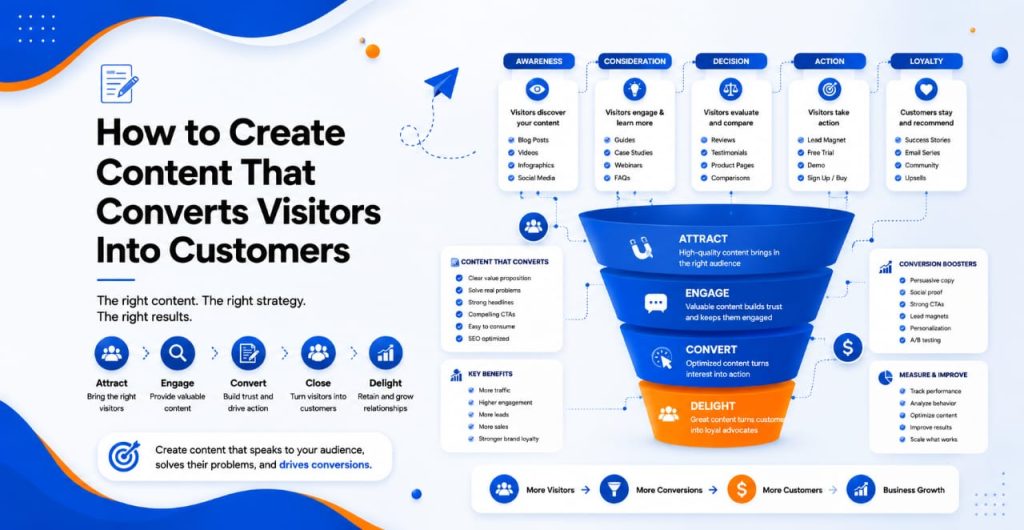
How to Create Content That Converts Visitors Into Customers

Introduction Did you know that most websites convert less than three percent of their visitors into paying customers? Traffic alone will not grow your business. Without strategic, conversion-focused content, even thousands of monthly visitors can leave without taking action. Learning how to create content that converts visitors into customers means understanding your audience, matching their intent, and guiding them confidently through the buyer journey. This guide breaks down exactly how to do that, step by step, with practical examples you can apply immediately What Is Conversion-Focused Content? Conversion-focused content is writing designed with a clear business goal in mind, whether that is a purchase, a signup, or a booked call. Unlike purely informative content, it blends education with persuasion. This distinction matters because informative content builds awareness, while conversion-focused content moves readers toward a decision. Businesses that combine both create a content funnel that nurtures leads from first click to final sale. Content Type Primary Goal Example Informative Content Educate and build awareness Blog post explaining a concept Conversion-Focused Content Drive a specific action Landing page with a clear CTA Trust-Building Content Reduce buyer hesitation Case study or testimonial page How to Create Content That Converts Visitors Into Customers The following ten strategies form a proven content marketing strategy for turning casual browsers into loyal, paying customers. 1. Understand Your Target Audience You cannot convert someone you do not understand. Build clear buyer personas that outline your audience’s goals, pain points, and objections before writing a single word. Example: A SaaS company selling project management software might discover its main users are overwhelmed team leads, not executives, and adjust its messaging accordingly. 2. Match Content to Search Intent Google rewards content that satisfies the intent behind a query, whether that intent is informational, navigational, or transactional. Example: An eCommerce brand ranking for “best running shoes for flat feet” should write a buying guide, not a generic product description. 3. Write Compelling Headlines Your headline determines whether visitors stay or leave. Strong headlines promise a clear benefit and spark curiosity. Example: Changing “Our Services” to “How Our Software Cuts Onboarding Time by 40%” immediately signals value. 4. Focus on Solving Customer Problems Every section of your content should answer a real question or resolve a real frustration your prospect has. Example: A digital agency blog that walks readers through fixing slow page speed builds authority while naturally showcasing expertise. 5. Build Trust with Social Proof and Case Studies Testimonials, reviews, and data-backed case studies reduce the perceived risk of taking action. Example: A startup adding “Trusted by 500+ small businesses” beside a client logo bar often sees stronger form completions. 6. Use Clear and Persuasive Calls-to-Action (CTAs) A strong call-to-action tells visitors exactly what to do next and why it benefits them. Example: Replacing “Submit” with “Get My Free Audit” consistently improves click-through rates. 7. Optimize Content for SEO and Readability Content must be discoverable and easy to scan, with clear headings, short paragraphs, and natural keyword placement. Example: A blog broken into scannable subheadings keeps mobile readers engaged far longer than dense text blocks. 8. Use Visuals to Improve Engagement Images, charts, and short videos break up text and help explain complex ideas quickly. Example: A comparison chart on a pricing page often reduces support questions and speeds up decisions. 9. Create High-Converting Landing Pages Landing pages should have one focused goal, minimal distractions, and a benefit-driven headline supported by proof. Example: Removing extra navigation links from a signup page can meaningfully increase completed registrations. 10. Measure, Test, and Improve Performance Conversion optimization is ongoing. Use analytics and A/B testing to refine headlines, CTAs, and layouts over time. Example: A marketing team testing two CTA colors might find one variant consistently outperforms the other. Common Mistakes That Reduce Content Conversions Writing only for search engines instead of real readers Weak or missing calls-to-action Ignoring user intent behind key search terms Poor website navigation that hides next steps Long, unreadable paragraphs that overwhelm visitors Lack of trust signals like reviews or case studies No performance tracking to guide improvements Best Tools for Creating High-Converting Content The right tools make it easier to research, write, and optimize content that performs. Tool Purpose Best For Google Analytics Tracks visitor behavior and conversion paths Measuring which content drives sales Google Search Console Monitors search performance and indexing Improving organic visibility Ahrefs Keyword research and backlink analysis Competitive SEO strategy SEMrush All-in-one SEO and content auditing Content gap analysis Grammarly Grammar and readability checking Polishing conversion copy Canva Visual and graphic design Creating engaging visuals Hotjar Heatmaps and session recordings Understanding user behavior HubSpot CRM and marketing automation Managing leads and CTAs Best Practices for Conversion-Focused Content Marketing Know your audience deeply before writing Prioritize user experience across every page Write benefit-driven copy, not just features Use strong, specific CTAs throughout your funnel Add testimonials and reviews for social proof Optimize every page for mobile devices Improve page speed to reduce bounce rate Update content regularly to stay accurate and ranked A/B test headlines and CTAs to find what works Key Takeaways Traffic without conversion-focused content rarely turns into revenue. Understanding audience intent is the foundation of high-converting content. Strong headlines and CTAs directly influence conversion rate optimization. Social proof reduces hesitation and builds buyer confidence. SEO and readability work together to keep visitors engaged. Landing pages should have one clear, focused goal. Continuous testing and measurement drive long-term improvement. Conclusion Learning how to create content that converts visitors into customers is not about tricks or shortcuts. It is about combining SEO, genuine value, trust-building, and compelling CTAs into a seamless customer journey. When every page on your site is built with the reader’s needs and your business goals in mind, visitors naturally become customers, and customers become long-term advocates for your brand. Take a moment to audit your existing content today. Identify weak CTAs, outdated pages, and missed opportunities, then start optimizing for conversions one page at a time. Frequently Asked Questions (FAQ)

Content Marketing

Evergreen Content vs Trending Content: Which Wins?

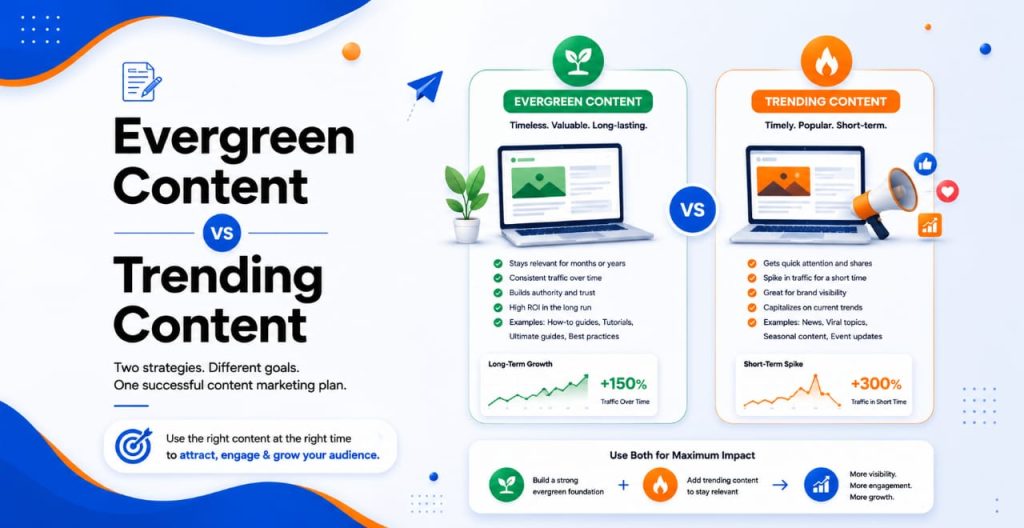
Introduction Should your next blog post chase this week’s headlines, or answer a question people will still be asking in five years? Most businesses never consciously choose. They just publish whatever feels urgent, then wonder why traffic is unpredictable. Evergreen content stays relevant for years, while trending content capitalizes on what is popular right now. Understanding evergreen content vs trending content is essential for long-term marketing success, since each type plays a different role in your traffic and revenue. This guide breaks down both types, compares them directly, and shows you how to balance them in one strategy. What Is Evergreen Content? Evergreen content is material that stays useful and accurate long after publication, without needing constant rewrites. It typically answers timeless questions rather than covering current events. Key characteristics include stable search demand, minimal maintenance, and a focus on foundational topics. For SEO, evergreen content is powerful because it keeps earning organic traffic and backlinks for years, compounding in value the longer it stays online. Common examples include: How-to guides and tutorials Glossaries and definition pages Beginner’s guides to a topic Case studies with lasting lessons What Is Trending Content? Trending content covers what is happening right now, from breaking news to viral topics. It is built for immediate relevance rather than lasting value. Its key characteristics are a short shelf life, high timeliness, and a strong connection to current conversations. The benefit is speed: trending content can drive a fast spike in traffic, social shares, and engagement while interest is at its peak. Common examples include: Reactions to industry news Product launch announcements Seasonal or holiday campaigns Posts riding a viral social trend Evergreen Content vs Trending Content Choosing between the two depends on your goals. Evergreen content builds a durable traffic base, while trending content creates short bursts of visibility. Feature Evergreen Content Trending Content Lifespan Years, with occasional updates Days to a few weeks SEO value Strong, compounds over time Minimal long-term SEO impact Traffic potential Slow, steady growth Fast initial spike, then decline Audience engagement Steady, ongoing interest High but short-lived Content maintenance Periodic updates needed Little to no maintenance Lead generation Consistent, compounding leads Short bursts of leads Marketing ROI High over the long term High but short-term only Ideal use case Guides, tutorials, resources News, launches, seasonal events Advantages and Disadvantages Evergreen Content Pros: consistent traffic, strong long-term SEO value, and content that keeps generating leads with no extra spend. Cons: slower initial results, and posts still need occasional updates to stay accurate. Trending Content Pros: fast traffic spikes, strong social shares, and quick opportunities to join relevant conversations. Cons: short lifespan, and content that can become irrelevant or even embarrassing once the trend fades. When Should Businesses Use Evergreen Content? Evergreen content works best as the foundation of most content strategies: Service businesses: how-to guides that answer common customer questions E-commerce: buying guides and product comparison pages B2B companies: definitive guides that support the full buyer journey Bloggers: cornerstone posts that anchor a niche and attract backlinks SaaS businesses: tutorials that reduce support tickets and build authority When Should Businesses Use Trending Content? Trending content earns its place when timing matters more than longevity: Reacting quickly to industry news relevant to your audience Announcing product launches while attention is highest Running seasonal campaigns tied to holidays or events Joining viral topics that naturally fit your brand voice Riding social media trends for a short engagement boost How to Balance Evergreen and Trending Content in Your Strategy The strongest content marketing strategy rarely chooses one type exclusively. Instead, it blends both with intention: Build a content calendar with a majority of evergreen posts and scheduled trend-based pieces Maintain an evergreen content library as your traffic and lead generation backbone Leverage trends quickly, but only when they genuinely fit your niche Update evergreen posts every six to twelve months to protect rankings Repurpose both content types across email, social, and video for wider reach Best Tools for Content Research and Planning Tool Purpose Best For Google Trends Tracks rising search interest over time Spotting trending topics early Google Analytics Measures traffic and content performance Comparing evergreen vs trending results Google Search Console Monitors rankings and indexing Tracking long-term evergreen SEO value Ahrefs Keyword and backlink research Finding evergreen topics with lasting demand SEMrush SEO audits and content gap analysis Planning a balanced content calendar BuzzSumo Finds trending and high-sharing content Identifying timely, shareable topics Canva Designs graphics and visuals Producing content for both content types Trello Organizes content calendars and tasks Managing evergreen and trending workflows Best Practices for a Successful Content Strategy Understand audience intent before choosing a topic Perform keyword research to confirm real search demand Combine evergreen and trending topics in your calendar Optimize every post for SEO from the first draft Add internal links to connect related content Update content regularly to keep it accurate Measure performance to see what actually drives results Improve underperforming content based on analytics, not guesses Key Takeaways Choosing between the two is not an either-or decision for most businesses. Evergreen content builds lasting SEO value and predictable organic traffic. Trending content delivers fast visibility and short-term engagement spikes. Service, e-commerce, B2B, and SaaS businesses all benefit from an evergreen foundation. Trending content works best for news, launches, and seasonal campaigns. A content calendar that blends both types produces the strongest marketing ROI. Regular updates keep evergreen posts accurate and competitive over time. Conclusion Evergreen content vs trending content is not really a competition; it is a balance every business needs to strike. Evergreen posts build the steady traffic and authority that sustain your business, while trending content adds timely bursts of visibility on top of that foundation. Review your current content strategy this week. Identify where you are missing an evergreen backbone or a timely trend, and build a balanced content mix that drives sustainable traffic, leads, and revenue. Frequently Asked Questions What is evergreen content? Evergreen content is material that stays relevant

Content Marketing

The Complete Content Marketing Funnel Explained

Introduction Why do most website visitors leave without ever becoming customers? In most cases, it is not the product that fails to convince them. It is the absence of a clear path guiding them from curiosity to purchase. A content marketing funnel solves this problem by mapping content to each stage of the buyer journey. Every business that publishes content, whether a blog, a newsletter, or social posts, needs one to turn casual readers into paying customers. This guide offers the complete content marketing funnel explained, covering every stage, practical strategies, and the tools that make it work. What Is a Content Marketing Funnel? A content marketing funnel is a structured system of content designed to move prospects from first discovering your brand to becoming loyal customers. Unlike a sales funnel, which focuses on transactions and deals, a content funnel focuses on education, trust, and relationship building that eventually leads to a sale. This distinction matters in modern digital marketing because buyers now research extensively before ever talking to a salesperson. A well-built content funnel meets them at each step with the right information. The benefits are significant: Higher-quality leads who already understand your value Shorter sales cycles thanks to pre-built trust More consistent, predictable lead generation Content that keeps working long after publication The Complete Content Marketing Funnel Explained Every funnel breaks down into three core stages, often referred to as TOFU, MOFU, and BOFU. Top of the Funnel (TOFU) – Awareness At this stage, the goal is simply to get discovered by people who have a problem but do not yet know your brand. Their mindset is exploratory; they are searching for information, not a purchase. Blog posts, infographics, and short videos work best here, since they answer broad questions without pushing a sale. SEO optimization plays a critical role, as most TOFU traffic arrives through organic search. A skincare brand publishing “how to build a morning skincare routine” is a classic TOFU example. Middle of the Funnel (MOFU) – Consideration Here, prospects know they have a problem and are actively comparing solutions. Lead nurturing becomes essential, since these readers are close to deciding but not quite ready to buy. Webinars, comparison guides, and email courses perform well at this stage. A project management tool offering a free guide comparing methodologies, gated behind an email signup, turns MOFU interest into a nurtured lead. Bottom of the Funnel (BOFU) – Conversion At the bottom, prospects are ready to decide and just need a final push. The decision-making process centers on proof: pricing, guarantees, and evidence that your solution works. Case studies, free trials, and demo requests are the best content types here, paired with direct calls-to-action like “Start Your Free Trial.” A software company offering a 14-day free trial at the end of a case study captures BOFU-ready leads effectively. How to Create Content for Every Funnel Stage Building a funnel that converts takes deliberate planning, not just publishing at random: Research your audience to understand their questions at each stage Perform keyword research to find terms with real search volume Match content to search intent so readers find what they expect Plan content around a calendar that covers all three funnel stages Use internal linking to guide readers from TOFU posts toward MOFU offers Distribute content across blogs, social media, and email Build email marketing workflows that nurture leads automatically Use retargeting ads to bring MOFU visitors back for a final decision Best Content Types for Each Funnel Stage Funnel Stage Goal Best Content Types CTA TOFU Build awareness Blog posts, infographics, short videos “Learn More” MOFU Nurture consideration Webinars, comparison guides, email courses “Get the Guide” BOFU Drive conversion Case studies, free trials, demo requests “Start Free Trial” Common Content Marketing Funnel Mistakes Ignoring audience intent and publishing content nobody searches for Publishing random topics with no connection to the funnel Using weak or generic CTAs that give readers no clear next step Skipping lead magnets, leaving MOFU visitors with no way to convert Neglecting SEO, which limits organic reach at the awareness stage Failing to track performance, so weak content never gets fixed Not nurturing leads after they enter the funnel, letting interest fade Best Tools for Managing a Content Marketing Funnel Tool Purpose Best For Google Analytics Tracks traffic and funnel behavior Measuring stage-by-stage performance Google Search Console Monitors search rankings and indexing Improving TOFU organic visibility HubSpot Manages content, CRM, and workflows Connecting the full funnel end to end Ahrefs Keyword and competitor research Planning content around search intent SEMrush SEO audits and content gap analysis Finding funnel content opportunities Canva Designs graphics and visuals Producing TOFU and MOFU visual content Mailchimp Sends and automates email campaigns Building MOFU nurture sequences Trello Organizes content calendars and tasks Planning content across funnel stages Best Practices for Building a High-Converting Content Marketing Funnel Understand your audience before creating a single piece of content Create content for every stage, not just the top of the funnel Use SEO strategically to attract the right visitors at each stage Offer lead magnets that match what MOFU readers are considering Build email workflows that nurture leads automatically over time Optimize CTAs so every page has one clear, specific next step Measure conversions at each stage to find where prospects drop off Update content regularly to keep it accurate and competitive Key Takeaways Understanding the full funnel shows how content guides buyers from awareness to purchase. TOFU, MOFU, and BOFU each require distinct goals, formats, and CTAs. SEO optimization drives the awareness stage, while nurturing drives consideration. Lead magnets and email marketing convert MOFU interest into sales-ready leads. Case studies and free trials give BOFU prospects the final push they need. Tracking performance at every stage reveals where the funnel needs improvement. A content funnel outperforms random publishing because every piece has a purpose Conclusion The complete content marketing funnel explained in this guide comes down to one core idea: content should meet buyers exactly where they are. Consistent, stage-specific

Content Marketing

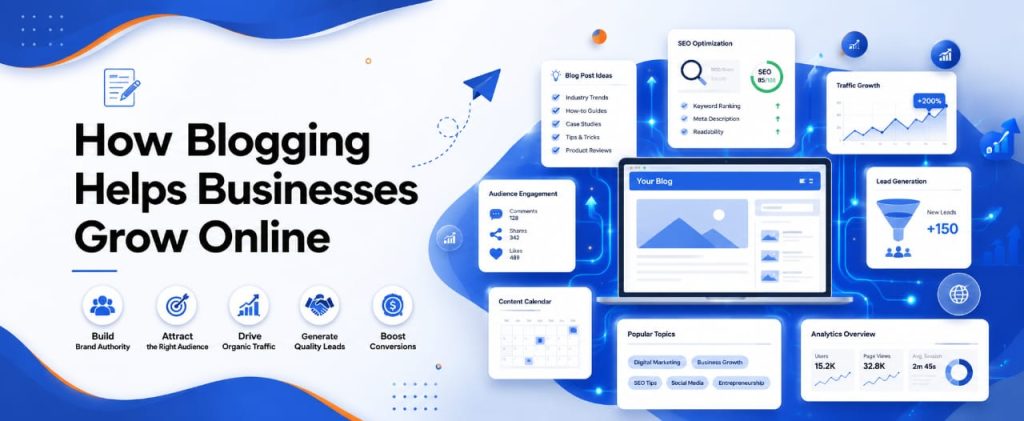
How Blogging Helps Businesses Grow Online

Introduction Do you know that companies with an active blog generate far more website visits than those without one? Yet many business owners still treat their website as a static brochure and wonder why traffic never grows. Most businesses struggle to grow online simply because they stop creating content. Without fresh, relevant pages, search engines have little reason to send new visitors your way. This article explains how blogging helps businesses grow online, and why it remains one of the most effective long-term digital marketing strategies available today. How Blogging Helps Businesses Grow Online Blogging sits at the center of a strong digital marketing strategy because it gives search engines new pages to index and new keywords to rank. Every blog post is another door through which potential customers can find you. Blogs also build trust and authority. When you consistently answer your audience’s questions, readers see your brand as a reliable expert rather than just another company trying to sell something. Over time, this trust compounds, turning one-time visitors into loyal customers and delivering marketing value that outlasts any single ad campaign. 8 Ways Business Blogging Drives Growth 1. Increases Organic Website Traffic Every published post is a new chance to appear in search results and attract organic traffic, without paying for ads. More indexed pages mean more ways for your audience to discover you. Publish consistently around topics your customers actually search for. A local bakery that blogs about seasonal recipes can attract steady search traffic from home bakers well beyond its area. 2. Improves SEO Rankings Search engines reward sites that publish fresh, well-structured content. SEO blogging signals that your site is active and worth crawling regularly. Use keyword research to guide topics, then optimize titles and headings. A software company targeting “project management tips” can climb rankings by publishing guides around that exact phrase. 3. Builds Brand Authority and Credibility Detailed, well-researched posts position your business as a knowledgeable voice in your industry, making prospects more comfortable choosing you over competitors. Write comprehensive guides that go deeper than surface-level advice. A financial advisor who publishes thorough retirement planning articles builds far more credibility than one with no online content. 4. Generates High-Quality Leads Blog posts that address specific customer problems attract readers who are already interested in your solution, making blogging one of the most efficient lead generation channels available. Pair each post with a relevant offer, such as a checklist or free consultation. A marketing agency blogging about social media trends can capture leads with a related audit at the end of the post. 5. Supports Content Marketing Strategy Blog posts feed a broader content marketing strategy, powering email newsletters, social posts, and sales materials. One strong article can fuel weeks of additional content. Plan blog topics around your overall marketing calendar rather than in isolation. An e-commerce brand can turn a single post into a product launch story across every channel it uses. 6. Improves Customer Engagement Blogs give customers a reason to return to your site beyond making a purchase. Comments, shares, and repeat visits all deepen customer engagement over time. Encourage discussion by ending posts with a question. A fitness studio that blogs about workout tips often sees members commenting and sharing their own progress. 7. Provides Valuable Content for Social Media and Email Marketing A single blog post can be repurposed into several social captions, an email newsletter, and even short video scripts, keeping every channel active without extra work. Break long posts into smaller snippets for different platforms. A consultant who publishes one post weekly can fill an entire month of email marketing and social content from that material alone. 8. Delivers Long-Term Marketing ROI Unlike paid ads that stop working once the budget runs out, blog posts keep attracting visitors for months or years after publishing, making blogging one of the strongest sources of long-term marketing ROI. Focus on evergreen topics that stay relevant over time. A home improvement company that publishes a guide on choosing flooring materials can keep earning traffic and leads long after the post goes live. Common Blogging Mistakes Businesses Should Avoid Publishing inconsistently, which stalls momentum with both readers and search engines. Ignoring SEO best practices, leaving well-written posts undiscoverable. Writing only promotional content instead of genuinely helpful information. Not understanding audience intent, so posts fail to answer what readers actually searched for. Using weak or missing CTAs, leaving readers with no clear next step. Failing to update older blog posts, letting once-strong rankings quietly decline. Best Tools for Business Blogging Tool Purpose Best For Google Analytics Tracks website traffic and visitor behavior Measuring blog performance and conversions Google Search Console Monitors search rankings and indexing health Fixing SEO issues and tracking keywords Ahrefs Keyword research and backlink analysis Planning topics with real search demand SEMrush Competitor research and SEO audits Agencies and teams managing multiple blogs Grammarly Checks grammar, clarity, and tone Polishing drafts before publishing Canva Designs blog graphics and social visuals Creating images without a design team WordPress Hosts and publishes blog content Building and managing the blog itself HubSpot Manages content, CRM, and lead tracking Connecting blogging to sales and marketing Best Practices for Creating Successful Business Blogs Understand your audience and write directly to their needs. Perform keyword research before drafting any post. Write engaging, specific headlines that promise a clear benefit. Use internal and external links to add context and credibility. Add visuals to break up text and illustrate key points. Optimize images with descriptive file names and alt text. Include clear CTAs that guide readers toward the next step. Update existing content regularly to protect rankings and accuracy. Key Takeaways Consistent, valuable content is what drives real online business growth through blogging. Blogging improves SEO rankings and drives organic traffic without ongoing ad spend. Well-researched posts build brand authority and customer trust over time. Blogging supports lead generation and feeds a broader content marketing strategy. Repurposed blog content strengthens social media and email marketing efforts. Avoiding

Content Marketing

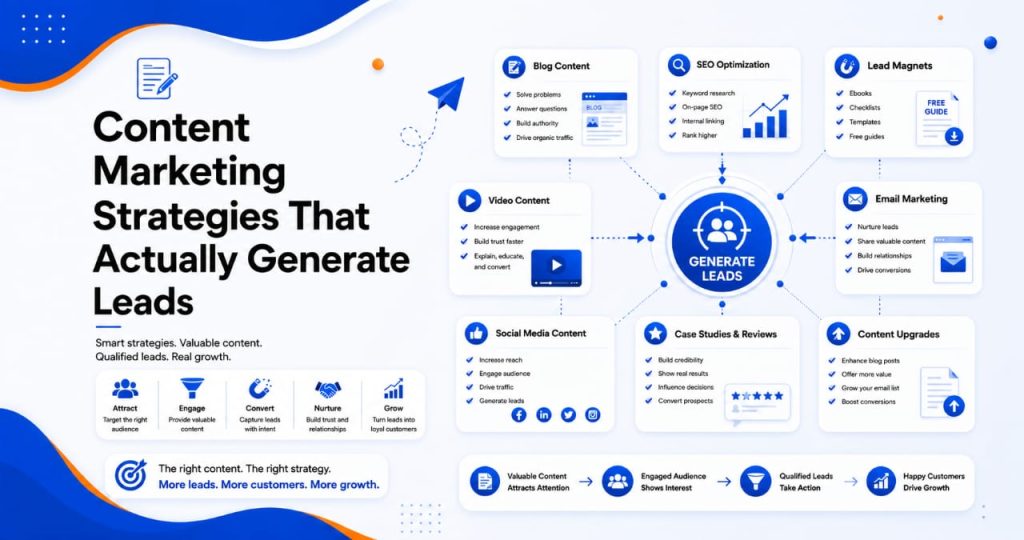
8 Content Marketing Strategies That Actually Generate Leads

Introduction Are you publishing blog posts every week but still waiting for leads to show up in your inbox? You are not alone. Many small business owners and marketing managers pour hours into content creation, only to watch traffic rise while sales conversations stay flat. The problem is rarely a lack of effort. It is usually a lack of strategy. Content marketing works only when every post, email, and social update is built around a clear path to conversion. In this article, you will learn why content marketing matters for lead generation, eight proven content marketing strategies you can apply right away, common mistakes that kill results, and tools that make execution easier. Why Content Marketing Matters for Lead Generation Valuable content builds trust before a prospect ever speaks with your sales team. When you answer real questions, readers start to see your brand as a credible source rather than just another vendor. That trust turns a stranger into a subscriber, and eventually into a customer. Content also nurtures prospects through every stage of the buying journey. A blog post might attract someone researching a problem, a case study can convince them your solution works, and a well-timed email can push them toward a decision. Without this connected content funnel, most visitors leave your site and never return. 8 Content Marketing Strategies That Actually Generate Leads 1. Know Your Target Audience You cannot create content that converts if you do not know who you are writing for. Build buyer personas that cover your audience’s goals, challenges, and the language they use when searching for solutions. Interview current customers and review support tickets for recurring questions. A SaaS company targeting startup founders might discover their audience cares more about implementation speed than price, which should shape every headline and CTA. 2. Create SEO-Optimized Blog Content SEO content brings in visitors who are already searching for what you offer, which makes them more likely to convert than cold traffic. Focus on keyword research, clear headings, and content that answers the searcher’s intent. Find low-competition keywords with real buyer intent, then structure posts with descriptive H2 and H3 headings. A local accounting firm that publishes a guide on small business tax deductions can rank for searches from owners actively looking for help. 3. Offer High-Value Lead Magnets A lead magnet trades something useful, like a checklist, template, or mini-course, for a visitor’s contact information. This works because it gives people a reason to share their email beyond simply liking your blog. Keep the offer specific and tied to the page it appears on. A marketing agency offering a “30-Day Social Media Content Calendar” on a social media post will convert better than a vague “free guide” popup. 4. Build an Email Nurture Funnel Most visitors are not ready to buy the first time they find your content, so an email nurture funnel keeps the conversation going. Helpful, well-timed emails build familiarity and move subscribers closer to a decision. Map out five to seven emails mixing education, social proof, and a clear offer near the end. An online course creator might send a welcome email, two lessons, a testimonial, and a discount code to encourage enrollment. 5. Repurpose Content Across Multiple Platforms Turning one blog post into several formats multiplies your reach without multiplying your workload. This content distribution approach also meets your audience where they already spend time. Turn a long post into a LinkedIn carousel, a short video script, and social media marketing snippets. A B2B consultant who repurposes one article into five LinkedIn posts often generates more inquiries than the original post alone. 6. Publish Case Studies and Customer Success Stories Case studies work because they show real proof instead of promises, which is what skeptical buyers want before committing. They translate features into outcomes a prospect can picture for their own business. Structure each story around the customer’s problem, your solution, and measurable results. A software company that publishes a case study showing a client cut onboarding time by 40 percent gives sales reps a powerful tool to share with leads. 7. Use Strong Calls-to-Action (CTAs) A CTA tells the reader exactly what to do next, and without one, even great content leads nowhere. Vague phrases like “learn more” rarely perform as well as CTAs tied to a specific benefit. Test action-oriented language such as “Get Your Free Marketing Audit” instead of “Submit.” An e-commerce brand that changed its CTA from “Subscribe” to “Get 15% Off” saw a noticeable lift in signups. 8. Track Performance and Optimize Regularly You cannot improve what you do not measure, so tracking performance protects your marketing ROI. Regular analysis shows which content actually drives leads and which pieces need reworking. Review traffic, conversion rates, and keyword rankings monthly, then double down on what works. A marketing manager who notices one post driving most demo requests can create similar content around that topic. Common Content Marketing Mistakes That Reduce Lead Generation Publishing Inconsistent Content Sporadic publishing makes it hard to build momentum with search engines or your audience. A realistic, consistent schedule beats an ambitious one you cannot maintain. Ignoring SEO Great writing without SEO content fundamentals means fewer people ever find it. Keyword research and on-page optimization should happen before you write, not after. Weak CTAs Content without a clear next step leaves readers to figure it out themselves, and most will simply leave. Every page needs a specific, benefit-driven action. Creating Content Without Understanding User Intent Ranking for a keyword means little if the content does not match what searchers want. Always ask what problem the reader is trying to solve before writing. Not Measuring Performance Skipping analytics means repeating the same mistakes. Set up tracking from day one so every piece of content can prove its worth. Recommended Tools Tool Purpose Best For Google Analytics Tracks website traffic and user behavior Measuring content performance and marketing ROI Google Search Console Monitors search rankings and indexing issues Improving SEO content and fixing

AI & Digital Marketing

AI-Powered Advertising: The Future of Customer Acquisition

AI-Powered Advertising: The Future of Customer Acquisition Imagine running an ad campaign that adjusts itself every few minutes, finds your ideal customer without you lifting a finger, and gets smarter with every click. That’s not a far-off dream anymore. It’s happening right now, and it’s called AI-powered advertising. Businesses that once spent hours manually tweaking bids and audiences are now letting machine learning do the heavy lifting. So, what does this actually mean for customer acquisition? Let’s break it down in plain English. What Is AI-Powered Advertising? AI-powered advertising uses machine learning to automate and improve how ads are targeted, created, and optimized. Instead of a human guessing which audience might convert, AI analyzes massive amounts of data to make that call in real time. This includes everything from automated bidding to AI-generated ad creative. In short, the algorithm handles the repetitive decisions so marketers can focus on strategy. How AI Improves Customer Acquisition Traditional advertising often relied on broad targeting and a lot of trial and error. AI flips that model by learning from real user behavior almost instantly. That means fewer wasted impressions, better-qualified leads, and a shorter path from first click to paying customer. For growing businesses, that efficiency directly affects the bottom line. Faster Learning, Lower Waste Because AI processes performance data continuously, it can shift budget away from underperforming ads within hours instead of weeks. That agility alone can meaningfully cut customer acquisition costs. Smart Audience Targeting Gone are the days of manually building audience segments based on guesswork. AI now identifies patterns across thousands of signals, browsing behavior, purchase history, and engagement patterns, to find people most likely to convert. For example, a fitness brand might discover through AI targeting that people who watch workout videos late at night convert better than daytime viewers, a pattern a human team would likely never spot manually. Predictive Analytics in Advertising Predictive analytics takes this a step further by forecasting future behavior based on past data. Instead of just reacting to what happened last week, AI can estimate what’s likely to happen next. This helps businesses plan budgets more confidently and spot high-potential customer segments before competitors do. Real-World Example A subscription box company might use predictive analytics to identify which website visitors are most likely to subscribe within the next 48 hours, then prioritize ad spend toward that exact group. Personalized Advertising at Scale Personalization used to mean swapping out a name in an email. Now, AI can tailor entire ad creatives, images, headlines, and offers, to match individual user preferences. That said, personalization has to be handled carefully. Ads that feel too specific can come across as invasive rather than helpful, so businesses need to strike a balance between relevance and comfort. Automated Bidding Explained Automated bidding uses AI to adjust how much you pay per click or conversion in real time, based on the likelihood of a sale. Instead of manually raising or lowering bids, the algorithm does it continuously. This is especially useful for businesses without a dedicated ad specialist on staff, since it removes a lot of the guesswork from day-to-day campaign management. Performance Optimization AI doesn’t just launch a campaign and walk away. It constantly tests creative variations, adjusts placements, and reallocates budget toward what’s actually working. This ongoing optimization is one of the biggest advantages of AI-powered advertising over traditional, manually managed campaigns. AI in Google Ads Google Ads has leaned heavily into automation through tools like Performance Max, which pulls in Search, YouTube, Display, and Shopping into one AI-managed campaign. It finds customers across channels based on the conversion signals you provide. Google has also rolled out AI Max for Search, which expands keyword matching and generates ad text directly from your landing pages. Early data shows meaningful lifts in conversions when advertisers use the full feature set instead of just one piece. Practical Tip Feed Google’s AI clean, accurate conversion data. The better the signals you provide, the smarter its targeting decisions become. AI in Meta Ads Meta’s Advantage+ campaigns work similarly, automating audience targeting, placement, and creative testing across Facebook and Instagram. Advertisers essentially provide a budget and goal, and the AI handles execution. Businesses that consolidate fragmented campaigns into Advantage+ structures often see noticeably lower cost-per-acquisition, since the algorithm has more data to learn from in one place. AI in Email Marketing AI also plays a growing role in email-based customer acquisition, not just retention. Smart send-time optimization, subject line testing, and behavior-based triggers all help move new leads toward their first purchase. For instance, an AI system might notice a new subscriber consistently opens emails on Sunday mornings and automatically shift future sends to match that pattern. AI in Remarketing Remarketing has always been about reaching people who didn’t convert the first time. AI makes this sharper by predicting which visitors are actually likely to return, rather than blasting ads to everyone who bounced. This reduces ad fatigue and keeps remarketing budgets focused on genuinely warm leads instead of casual browsers who were never going to buy. Advantages of AI-Powered Advertising Faster optimization and reduced manual work More accurate audience targeting Lower customer acquisition costs over time Scalable personalization across large audiences Challenges to Keep in Mind AI advertising isn’t without its downsides. Many platforms operate as a bit of a “black box,” making it hard to see exactly why a decision was made. There’s also a risk of AI campaigns taking credit for conversions that would have happened anyway through organic search or direct traffic. Running periodic tests, like pausing a campaign for a small segment, helps confirm whether the AI is actually driving new demand. Future Trends in AI Advertising Expect AI to keep pushing deeper into conversational and generative search experiences, where ads appear directly inside AI-generated answers rather than traditional search results. Voice search and multimodal queries will likely reshape targeting even further. Businesses that adapt early to these shifts will likely have an edge over those still relying on

AI & Digital Marketing

How to Use ChatGPT for Content Marketing

How to Use ChatGPT for Content Marketing Staring at a blank document, deadline creeping closer, and absolutely no idea where to start? Every content marketer knows that feeling. That’s exactly where ChatGPT has become a game-changer. It won’t replace your creativity, but it can absolutely speed up the boring, time-consuming parts of your job. In this guide, we’ll walk through exactly how to use ChatGPT for content marketing, from blog writing to ad copy, with real prompt examples you can copy and adjust today. What Is ChatGPT? ChatGPT is an AI chatbot that understands natural language and generates human-like text based on whatever you ask it. Think of it as a fast, tireless writing assistant that never runs out of ideas. You type a request, called a prompt, and it responds with a draft, an outline, a list, or basically any kind of written content you need. Why Marketers Use ChatGPT Content marketing runs on constant output: blogs, emails, captions, ads, and more, week after week. That volume is exhausting to produce alone. ChatGPT helps marketers move faster without sacrificing quality, as long as it’s used thoughtfully. It’s especially useful for first drafts, brainstorming, and repetitive writing tasks that eat up hours every week. That said, it works best as a starting point, not a finished product. More on that later. Using ChatGPT for Blog Writing Blog posts are one of the most common ways marketers use ChatGPT for content marketing, and for good reason. It can turn a rough idea into a structured draft in minutes. Prompt example: “Write a blog outline on [topic] for beginners, including H2 headings and a short intro.” Once you have the outline, ask ChatGPT to expand each section one at a time. This keeps the writing focused and easier to edit than generating one giant block of text. Editing AI Drafts Never publish a ChatGPT draft as-is. Add your own examples, opinions, and brand voice, then fact-check anything specific like statistics or dates. Writing Social Media Captions Short-form captions need punch, and ChatGPT is great at generating multiple variations quickly so you can pick the best one. Prompt example: “Write 5 Instagram captions for a coffee shop promoting a new seasonal drink, casual tone, under 30 words each.” Ask for different tones (funny, professional, inspiring) if you’re not sure what fits your brand best. Email Marketing with ChatGPT Email still drives strong ROI, and ChatGPT can help with subject lines, body copy, and even A/B test variations. Prompt example: “Write 3 subject lines and one email body for a Black Friday sale, friendly and urgent tone.” Keep your emails personal by editing in specific details ChatGPT doesn’t know, like real customer names, past purchase history, or seasonal context. Creating SEO Content ChatGPT can help structure SEO-friendly content, but it doesn’t have live access to current search rankings, so pair it with a proper SEO tool for keyword data. Prompt example: “Write a meta description under 155 characters for a blog about [topic], including the keyword [keyword].” It’s also useful for generating FAQ sections, since it can quickly draft several common questions and answers around your topic. Keyword Research Support ChatGPT won’t replace tools like Semrush or Ahrefs for real search volume data, but it’s handy for generating keyword ideas and related terms to explore further. Prompt example: “Give me 15 keyword variations and related search phrases for the topic [topic].” Always verify these suggestions with an actual keyword research tool before building content around them. Writing Product Descriptions If you manage an online store, writing dozens of product descriptions manually is exhausting. ChatGPT can draft them fast, especially when you give it clear product details. Prompt example: “Write a 60-word product description for a waterproof hiking backpack, highlighting durability and comfort.” Feed it your product specs directly for more accurate, specific descriptions instead of generic filler text. Generating Ad Copy Paid ads need to grab attention fast, and ChatGPT can generate several headline and copy variations for A/B testing. Prompt example: “Write 5 Google Ads headlines (30 characters max) for a fitness app targeting busy professionals.” Testing multiple AI-generated variations against each other often reveals which angle resonates before you spend your full ad budget. Brainstorming Content Ideas Running out of fresh topics is one of the most common content marketing struggles. ChatGPT is genuinely useful here because it can generate dozens of angles in seconds. Prompt example: “Give me 20 blog topic ideas for a [industry] audience, focused on beginner-level questions.” Building a Content Calendar ChatGPT can also help structure a content calendar, suggesting which topics to publish and when, based on your goals. Prompt example: “Create a 4-week content calendar for a skincare brand, including one blog, two social posts, and one email per week.” This gives you a starting framework you can adjust based on real performance data and seasonal trends. Repurposing Content One blog post can become five different pieces of content, and ChatGPT makes that repurposing process much faster. Prompt example: “Turn this blog post into a Twitter thread, a LinkedIn post, and three Instagram caption ideas: [paste content].” This is one of the most underused ChatGPT for content marketing strategies, since most teams create content once and never reuse it. Best Practices for Using ChatGPT Always edit AI output before publishing. Add real examples, personal insights, and your brand’s unique voice. Fact-check anything specific, including statistics, dates, and claims. ChatGPT can sound confident even when it’s wrong. Use it as a first draft tool, not a final product. The best content still needs a human editor’s judgment. Common Mistakes to Avoid Publishing raw AI content without editing is the biggest mistake marketers make. It often sounds generic and can hurt reader trust. Relying on ChatGPT for current events or real-time data is another common error, since its knowledge has a cutoff date. Using vague prompts is also a frequent issue. The more specific your prompt, the more useful the output will be. Expert Tips for Better

AI & Digital Marketing

Can AI Replace Digital Marketing Agencies?

Picture this: a business owner cancels their agency contract, signs up for a handful of AI tools, and expects the same results by next month. Sounds tempting, right? It’s a question a lot of business owners are quietly asking in 2026. AI can write blog posts, design ads, and even schedule campaigns in minutes. So why keep paying an agency at all? The honest answer is more nuanced than a simple yes or no. Let’s dig into what AI can actually do, what it still can’t, and whether agencies are really on their way out. What AI Can Do AI has gotten remarkably good at the repetitive, data-heavy parts of marketing. That’s not a small thing, it’s actually where a lot of agency hours used to go. Content and Ad Production AI tools can now draft blog posts, write ad copy, and generate social captions in a fraction of the time it used to take. Bulk content production, once a major agency line item, has become far cheaper to produce. Data Analysis and Reporting AI can process campaign data instantly, spot patterns, and generate performance reports without a human spending hours in a spreadsheet. This used to be a junior-level task; now it’s largely automated. Campaign Optimization Platforms like Google Ads and Meta already use AI to adjust bids, targeting, and budgets automatically. This kind of moment-to-moment optimization is something machines genuinely do better than people. What AI Cannot Do Here’s where things get interesting. Despite all the automation, AI still runs into real limits. Understanding Context and Culture AI works from patterns in data, not lived experience. There have been real cases of automated campaigns going out on the wrong day in a specific region simply because the system didn’t know it was a local day of mourning. A human strategist would have caught that instantly. Reading Between the Lines AI can summarize customer feedback, but it can’t always sense the emotional undertone in a tense client call or read a room during a pitch meeting. Making Judgment Calls Under Uncertainty When a campaign underperforms for unclear reasons, someone still needs to make a judgment call about what to try next. That’s pattern recognition built on years of experience, not something a model can fully replicate. The Role of Creativity Good marketing isn’t just accurate, it’s memorable. AI can remix existing ideas convincingly, but true creative breakthroughs, the kind that make a brand unforgettable, still tend to come from human insight. Think about a genuinely surprising ad campaign that made you stop scrolling. Chances are it came from a person who understood a cultural moment in a way a model simply couldn’t predict. Human Strategy Still Matters Strategy isn’t about producing more content faster. It’s about deciding what to say, to whom, and why it matters right now. AI can suggest options based on past data, but it can’t set a long-term business direction or weigh trade-offs the way an experienced strategist can. That’s a skill built through years of client exposure, not training data. Branding Needs a Human Touch A brand is more than a logo and a color palette. It’s a personality, a promise, and a set of values that a business stands behind. AI can help maintain consistency once a brand voice is defined, but defining that voice in the first place, the tone, the values, the emotional positioning, is still fundamentally a human decision. Client Communication Managing client relationships involves reassurance, negotiation, and sometimes delivering hard truths. No one wants to hear “we’re behind on results” from a chatbot. Agencies that thrive in 2026 are the ones whose people can explain the “why” behind a strategy, not just report the numbers. Campaign Management: Automation vs. Human Expertise Automation handles the mechanical parts of a campaign well: bidding, scheduling, A/B test variants. But someone still needs to decide what the campaign is trying to achieve and whether it fits the broader business goal. In practice, most successful agencies now use AI for execution and reserve human judgment for direction. That combination consistently outperforms either approach used alone. Advantages and Disadvantages of AI in Marketing Advantages: Faster turnaround on content and reporting Lower cost for repetitive tasks Data processing at a scale humans can’t match Round-the-clock campaign monitoring Disadvantages: Can misread cultural or emotional context Struggles with truly original creative direction Requires human oversight to catch errors Can feel impersonal in client relationships AI vs. Marketing Agencies: A Quick Comparison Factor AI Tools Marketing Agencies Speed Extremely fast Slower, but more deliberate Cost Lower for routine tasks Higher, but includes strategy Creativity Good at remixing ideas Better at original thinking Client relationships Limited, transactional Personal, relationship-driven Strategic judgment Weak in ambiguous situations Strong, built on experience Cultural sensitivity Prone to blind spots Better contextual awareness Will AI Replace Agencies, or Work Alongside Them? Based on how the industry is actually shifting, full replacement looks unlikely, at least for agencies doing real strategic work. What’s changing is the shape of the agency itself. Many agencies are hiring fewer junior staff for repetitive execution tasks, while investing more in senior strategists who know how to direct AI tools effectively. In other words, the agencies struggling most are the ones whose entire value was “we’ll produce content for you”, work that software can now do for a fraction of the price. Agencies that survive and grow are pairing AI’s speed with human strategy, creativity, and relationship management. That combination, not either extreme, is where the real advantage lies. Practical Business Examples A small e-commerce brand might use AI to generate dozens of ad variations for testing, but still rely on an agency to decide which brand story to tell during a holiday campaign. A B2B software company might use AI-driven reporting tools to track campaign performance daily, while depending on agency strategists to reposition their messaging when a competitor changes the market. In both cases, AI speeds up execution. Humans still decide what’s worth executing. Conclusion So, can AI

AI & Digital Marketing

Best AI Tools for Digital Marketers

Remember when running a full marketing campaign meant juggling ten browser tabs, three spreadsheets, and a headache by 3 PM? Those days are fading fast. In 2026, AI has quietly slipped into almost every part of a marketer’s workflow. It writes first drafts, spots SEO gaps, edits video, and even chats with your customers while you sleep. But here’s the catch: there are hundreds of tools out there, and not all of them are worth your time or budget. That’s why we’ve put together this guide to the best AI tools for digital marketers, covering exactly what each one does, who it’s for, and what it costs. Why AI Tools Matter for Digital Marketers Marketing teams today are expected to publish more content, run more campaigns, and prove more results, often with the same headcount as three years ago. AI tools help close that gap by handling repetitive, time-consuming work. That frees marketers up to focus on strategy, creativity, and the kind of thinking a machine still can’t replace. The result? Faster turnaround times, sharper targeting, and campaigns that improve themselves as they run. Content Writing Tools Jasper Features: Brand voice training, campaign-level content generation, and collaborative workspaces for teams. Benefits: Keeps tone and messaging consistent across dozens of writers and channels. Best use case: Marketing teams of three or more people who need on-brand content at scale. Pricing: Paid, starting around $49–59 per month. ChatGPT / Claude Features: Flexible, conversational writing help for outlines, drafts, and brainstorming. Benefits: Great thinking partner for early-stage ideas and quick edits, with no rigid templates. Best use case: Solo marketers or small teams who don’t need heavy brand-voice automation. Pricing: Free tier available; paid plans typically start around $20 per month. Frase Features: Keyword-based content briefs and structured, SEO-ready drafts. Benefits: Speeds up the research-to-draft process for blog content. Best use case: Content teams prioritizing organic search traffic. Pricing: Paid, budget-friendly compared to competitors like Surfer. SEO Tools Surfer SEO Features: Real-time content scoring based on top-ranking pages, keyword clustering, and topical authority mapping. Benefits: Takes the guesswork out of on-page optimization while you write. Best use case: SEO specialists and content marketers focused on organic growth. Pricing: Paid, plans generally start around $69 per month. Semrush Features: Broad SEO suite covering site audits, backlink analysis, and competitor tracking. Benefits: One dashboard for almost every SEO metric you’d otherwise track separately. Best use case: Agencies and in-house teams managing multiple SEO projects at once. Pricing: Paid, with tiered plans for freelancers up to large teams. Keyword Research Tools MarketMuse Features: Topical authority modeling that shows content gaps across your entire site. Benefits: Helps you build genuine expertise around a subject instead of chasing single keywords. Best use case: Teams building long-term content hubs, not just one-off blog posts. Pricing: Paid, typically enterprise-friendly. Semrush Keyword Magic Tool Features: Massive keyword database with intent and difficulty scoring. Benefits: Quickly surfaces low-competition keywords worth targeting. Best use case: Marketers planning new content calendars. Pricing: Included in Semrush subscriptions. Graphic Design Tools Canva Magic Studio Features: AI-generated layouts, text, image edits, and video, all inside one design tool. Benefits: Lets non-designers produce polished visuals without switching between apps. Best use case: Small teams and solo marketers who need social graphics, ads, and blog headers fast. Pricing: Free tier available; Pro plans start around $15 per month. Video Editing Tools VEED.IO Features: Auto-subtitles, noise removal, brand kits, and one-click resizing for social platforms. Benefits: Turns raw footage into publish-ready content without a professional editor. Best use case: Marketing teams making quick, on-brand social videos. Pricing: Free tier available; paid plans start around $9–19 per month. Descript Features: Text-based editing, so cutting a sentence from the transcript cuts it from the video too. Benefits: Makes editing talking-head content almost as easy as editing a document. Best use case: Podcasters, webinar hosts, and content marketers repurposing long-form video. Pricing: Free tier available; paid plans scale with usage. Email Marketing Tools Mailchimp Features: AI-assisted subject lines, send-time optimization, and audience segmentation. Benefits: Beginner-friendly interface with enough automation for most small businesses. Best use case: Startups and small teams sending their first automated campaigns. Pricing: Free tier available; paid plans scale with subscriber count. ActiveCampaign / Klaviyo Features: Advanced behavioral triggers, predictive send times, and deep e-commerce integrations. Benefits: Personalizes emails based on real customer behavior, not just demographics. Best use case: E-commerce brands and growing companies with more complex customer journeys. Pricing: Paid, scaling with contact list size. Social Media Tools Hootsuite / Buffer Features: AI-suggested posting times, content calendars, and cross-platform scheduling. Benefits: Saves hours of manual scheduling and helps maintain a consistent posting rhythm. Best use case: Teams managing multiple social accounts at once. Pricing: Free tiers available; paid plans start around $4–15 per month per channel. Automation Tools HubSpot Features: CRM, email automation, landing pages, and AI-driven lead scoring in one platform. Benefits: Reduces the need to stitch together five separate subscriptions. Best use case: Growing businesses that want marketing and sales data in one place. Pricing: Free CRM available; paid plans jump significantly at higher tiers. Zapier Features: No-code workflow automation connecting thousands of apps. Benefits: Automates repetitive handoffs between tools your team already uses. Best use case: Marketers who need custom automation without hiring a developer. Pricing: Free tier available; paid plans scale with usage volume. Analytics Tools Semrush / HubSpot Analytics Features: Traffic tracking, campaign performance dashboards, and predictive insights. Benefits: Turns raw numbers into clear next steps instead of just charts. Best use case: Teams that want one place to measure SEO, ads, and content together. Pricing: Included in existing Semrush or HubSpot subscriptions. Brand24 Features: Real-time brand mention tracking with sentiment analysis across the web and social media. Benefits: Flags negative feedback early, before it turns into a bigger problem. Best use case: Brands that want to monitor reputation alongside performance metrics. Pricing: Paid, with tiered monthly plans. Chatbot Tools Manychat Features: No-code chatbot builder for Instagram, Facebook, and WhatsApp conversations. Benefits:

Scroll to Top