
The Complete Customer Journey in Digital Marketing
Ever wonder why some businesses seem to turn casual browsers into loyal customers almost effortlessly, while others struggle to convert even highly interested visitors? The answer usually comes down to one thing: they understand the customer journey.
The customer journey in digital marketing isn’t just a buzzword marketers throw around in strategy meetings. It’s the actual path a person takes from the moment they first hear about your brand to the moment they become a repeat buyer — and hopefully, an advocate who brings you more customers. Understanding this journey is critical because it directly impacts your conversions, your customer experience, and ultimately, your revenue. When you know where people get stuck or drop off, you can fix it. When you don’t, you’re basically guessing.
In this guide, we’ll break down the entire digital customer journey, stage by stage, and show you exactly how to optimize it using SEO, content, social media, email, paid ads, and automation.
What Is the Customer Journey?
The customer journey is the complete experience a person has with your brand — from first discovering you to becoming a paying, returning customer. It spans every interaction: a Google search, a social media scroll, a blog read, an email open, a product page visit, a purchase, and beyond.
Unlike a simple sales funnel, the customer journey isn’t always linear. People jump back and forth between stages, research on multiple devices, and take their time. That’s exactly why mapping it out matters so much.
Why Customer Journey Mapping Matters
Customer journey mapping is the process of visually plotting out every touchpoint a customer has with your brand. Think of it as a roadmap of your customer’s experience.
Here’s why it matters:
- It reveals gaps and friction points where potential customers drop off.
- It aligns your marketing, sales, and support teams around a single customer view.
- It improves personalization, since you know exactly what content to serve at each stage.
- It boosts customer experience and retention, which is far cheaper than acquiring new customers.
A well-mapped journey turns guesswork into strategy.
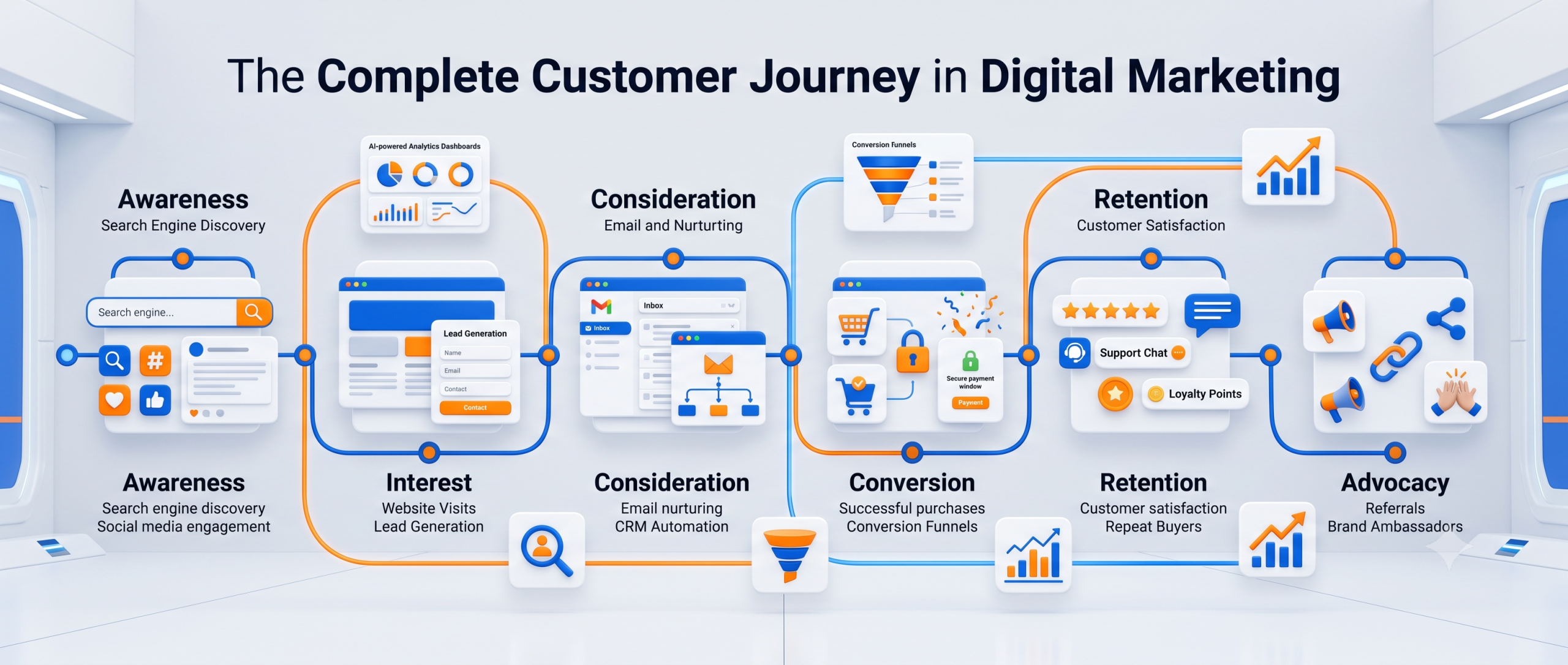
The Five Stages of the Customer Journey
1. Awareness
This is where potential customers first learn you exist. They might discover you through a blog post, a social media ad, a Google search, or word of mouth. Your job here is visibility — show up where your audience is already looking.
2. Consideration
Now they know you exist, and they’re comparing options. This stage is all about education. Comparison guides, case studies, and detailed product content help nudge them forward.
3. Decision
This is the make-or-break moment. The buyer is ready to purchase but needs that final push — a discount, a strong testimonial, a clear call-to-action, or a frictionless checkout experience.
4. Retention
Getting the sale is just the beginning. Retention focuses on keeping customers happy through onboarding, support, and continued value so they keep coming back.
5. Advocacy
Happy customers become your best marketers. At this stage, they leave reviews, refer friends, and promote your brand organically — often more effectively than any ad campaign could.
Example flow: A user sees an Instagram ad (Awareness) → reads a blog comparison (Consideration) → receives a retargeting email with a discount code (Decision) → gets a helpful onboarding sequence (Retention) → leaves a five-star review and refers a friend (Advocacy).
Customer Touchpoints Explained
Touchpoints are every single interaction a customer has with your brand — your website, social media, ads, emails, live chat, reviews, and even customer support calls. Mapping these touchpoints helps you understand where you’re winning and where you’re losing people.
How SEO Supports Every Stage
SEO isn’t just for driving traffic — it supports the entire buyer journey:
- Awareness: Blog posts and informational content targeting broad search queries.
- Consideration: Comparison articles, “best of” lists, and in-depth guides.
- Decision: Optimized product and landing pages with strong intent-based keywords.
- Retention: Help center content and FAQ pages that reduce support friction.
Role of Content Marketing
Content marketing fuels every stage of the digital marketing funnel. Blog posts build awareness, case studies support consideration, product pages drive decisions, and email newsletters nurture retention. Consistent, valuable content builds trust — and trust is what converts.
Social Media Across the Customer Journey
Social platforms aren’t just for brand awareness anymore. They influence consideration through reviews and user-generated content, support decisions through social proof, and drive retention through community engagement. A brand that responds to comments and DMs builds genuine loyalty.
Email Marketing and Lead Nurturing
Email remains one of the highest-ROI channels for lead nurturing. A well-structured email sequence can guide a lead from curiosity to purchase:
- Welcome email introducing your brand
- Educational emails addressing pain points
- Social proof (testimonials, case studies)
- A time-sensitive offer to prompt decision-making
Paid Advertising in the Customer Journey
Paid ads accelerate every stage when used strategically. Top-of-funnel ads build awareness, retargeting ads nudge consideration and decision, and loyalty-focused ads support retention. The key is matching ad messaging to the customer’s current stage — not blasting the same offer to everyone.
Personalization and AI Automation
AI-powered personalization is reshaping the customer experience. Tools can now automatically recommend products, personalize email content, and predict what a user needs next based on behavior. Brands using AI automation see higher engagement because customers feel understood, not marketed at.
Common Customer Journey Mistakes
- Treating the journey as strictly linear
- Ignoring post-purchase experience
- Failing to align marketing and sales messaging
- Not tracking touchpoints across devices
- Overlooking customer feedback and reviews
Best Tools for Customer Journey Mapping
- HubSpot – CRM with built-in journey tracking
- Google Analytics 4 – behavior and touchpoint data
- Miro or Lucidchart – visual journey mapping
- Hotjar – heatmaps and session recordings
- Salesforce – enterprise-level customer lifecycle management
Future Trends in Customer Experience (2026)
Expect deeper AI integration, hyper-personalized content at scale, voice and conversational search shaping awareness, and privacy-first data strategies as third-party cookies fade out. Brands that adapt to these shifts early will have a real competitive edge.
Conclusion
Mastering the customer journey in digital marketing isn’t optional anymore — it’s essential. From awareness to advocacy, every stage offers an opportunity to build trust, improve experience, and drive conversions. Start by mapping your own customer journey today, identify the gaps, and optimize each touchpoint with intention.
Ready to map your customer journey? Start small — pick one stage, audit your current touchpoints, and improve it this week.
Frequently Asked Questions
1. What are the five stages of the customer journey? Awareness, Consideration, Decision, Retention, and Advocacy.
2. How is the customer journey different from a marketing funnel? The funnel is a simplified, linear model, while the customer journey reflects the real, often non-linear path customers take across multiple touchpoints.
3. Why is customer journey mapping important for small businesses? It helps identify where potential customers drop off, allowing even small teams to fix friction points and improve conversions without increasing ad spend.
4. What tools help with customer journey mapping? HubSpot, Google Analytics 4, Hotjar, and Miro are popular choices for tracking and visualizing the journey.
5. How does personalization improve the customer journey? It delivers relevant content and offers based on user behavior, increasing engagement and making customers feel valued at every stage.