July 13, 2026

Lead Generation & Business Growth

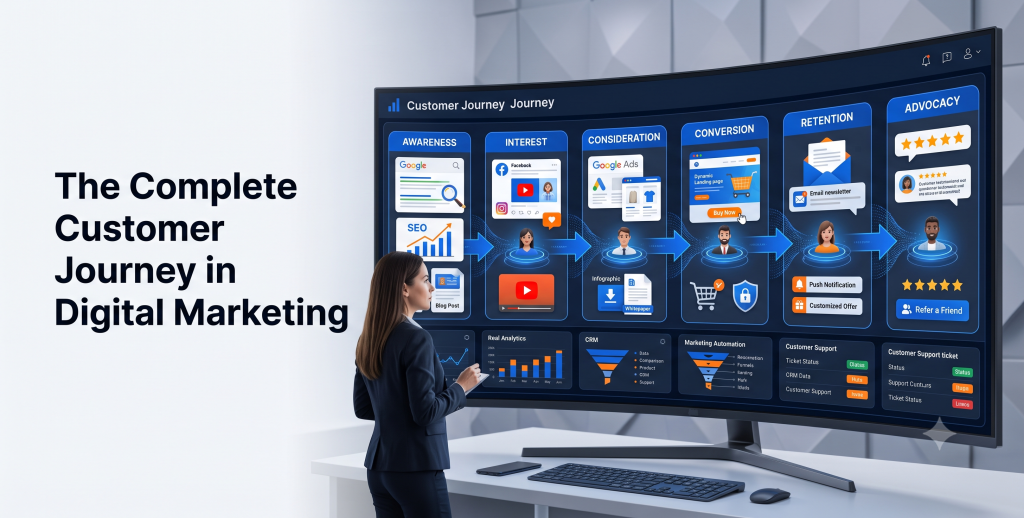
The Complete Customer Journey in Digital Marketing

The Complete Customer Journey in Digital Marketing Ever wonder why some businesses seem to turn casual browsers into loyal customers almost effortlessly, while others struggle to convert even highly interested visitors? The answer usually comes down to one thing: they understand the customer journey. The customer journey in digital marketing isn’t just a buzzword marketers throw around in strategy meetings. It’s the actual path a person takes from the moment they first hear about your brand to the moment they become a repeat buyer — and hopefully, an advocate who brings you more customers. Understanding this journey is critical because it directly impacts your conversions, your customer experience, and ultimately, your revenue. When you know where people get stuck or drop off, you can fix it. When you don’t, you’re basically guessing. In this guide, we’ll break down the entire digital customer journey, stage by stage, and show you exactly how to optimize it using SEO, content, social media, email, paid ads, and automation. What Is the Customer Journey? The customer journey is the complete experience a person has with your brand — from first discovering you to becoming a paying, returning customer. It spans every interaction: a Google search, a social media scroll, a blog read, an email open, a product page visit, a purchase, and beyond. Unlike a simple sales funnel, the customer journey isn’t always linear. People jump back and forth between stages, research on multiple devices, and take their time. That’s exactly why mapping it out matters so much. Why Customer Journey Mapping Matters Customer journey mapping is the process of visually plotting out every touchpoint a customer has with your brand. Think of it as a roadmap of your customer’s experience. Here’s why it matters: It reveals gaps and friction points where potential customers drop off. It aligns your marketing, sales, and support teams around a single customer view. It improves personalization, since you know exactly what content to serve at each stage. It boosts customer experience and retention, which is far cheaper than acquiring new customers. A well-mapped journey turns guesswork into strategy. The Five Stages of the Customer Journey 1. Awareness This is where potential customers first learn you exist. They might discover you through a blog post, a social media ad, a Google search, or word of mouth. Your job here is visibility — show up where your audience is already looking. 2. Consideration Now they know you exist, and they’re comparing options. This stage is all about education. Comparison guides, case studies, and detailed product content help nudge them forward. 3. Decision This is the make-or-break moment. The buyer is ready to purchase but needs that final push — a discount, a strong testimonial, a clear call-to-action, or a frictionless checkout experience. 4. Retention Getting the sale is just the beginning. Retention focuses on keeping customers happy through onboarding, support, and continued value so they keep coming back. 5. Advocacy Happy customers become your best marketers. At this stage, they leave reviews, refer friends, and promote your brand organically — often more effectively than any ad campaign could. Example flow: A user sees an Instagram ad (Awareness) → reads a blog comparison (Consideration) → receives a retargeting email with a discount code (Decision) → gets a helpful onboarding sequence (Retention) → leaves a five-star review and refers a friend (Advocacy). Customer Touchpoints Explained Touchpoints are every single interaction a customer has with your brand — your website, social media, ads, emails, live chat, reviews, and even customer support calls. Mapping these touchpoints helps you understand where you’re winning and where you’re losing people. How SEO Supports Every Stage SEO isn’t just for driving traffic — it supports the entire buyer journey: Awareness: Blog posts and informational content targeting broad search queries. Consideration: Comparison articles, “best of” lists, and in-depth guides. Decision: Optimized product and landing pages with strong intent-based keywords. Retention: Help center content and FAQ pages that reduce support friction. Role of Content Marketing Content marketing fuels every stage of the digital marketing funnel. Blog posts build awareness, case studies support consideration, product pages drive decisions, and email newsletters nurture retention. Consistent, valuable content builds trust — and trust is what converts. Social Media Across the Customer Journey Social platforms aren’t just for brand awareness anymore. They influence consideration through reviews and user-generated content, support decisions through social proof, and drive retention through community engagement. A brand that responds to comments and DMs builds genuine loyalty. Email Marketing and Lead Nurturing Email remains one of the highest-ROI channels for lead nurturing. A well-structured email sequence can guide a lead from curiosity to purchase: Welcome email introducing your brand Educational emails addressing pain points Social proof (testimonials, case studies) A time-sensitive offer to prompt decision-making Paid Advertising in the Customer Journey Paid ads accelerate every stage when used strategically. Top-of-funnel ads build awareness, retargeting ads nudge consideration and decision, and loyalty-focused ads support retention. The key is matching ad messaging to the customer’s current stage — not blasting the same offer to everyone. Personalization and AI Automation AI-powered personalization is reshaping the customer experience. Tools can now automatically recommend products, personalize email content, and predict what a user needs next based on behavior. Brands using AI automation see higher engagement because customers feel understood, not marketed at. Common Customer Journey Mistakes Treating the journey as strictly linear Ignoring post-purchase experience Failing to align marketing and sales messaging Not tracking touchpoints across devices Overlooking customer feedback and reviews Best Tools for Customer Journey Mapping HubSpot – CRM with built-in journey tracking Google Analytics 4 – behavior and touchpoint data Miro or Lucidchart – visual journey mapping Hotjar – heatmaps and session recordings Salesforce – enterprise-level customer lifecycle management Future Trends in Customer Experience (2026) Expect deeper AI integration, hyper-personalized content at scale, voice and conversational search shaping awareness, and privacy-first data strategies as third-party cookies fade out. Brands that adapt to these shifts early will have a real competitive edge. Conclusion

Lead Generation & Business Growth

Digital Marketing ROI: How to Measure Success

Ask any business owner if their marketing is “working,” and most will say yes. Ask them to prove it with numbers, and the confidence often disappears. That gap between feeling successful and knowing you’re successful is exactly why digital marketing ROI matters. Without it, you’re making budget decisions based on gut feeling instead of evidence. And in a market where every dollar counts, that’s a risky way to run a business. This guide breaks down exactly how to measure digital marketing ROI, the tools that make it easier, and the mistakes that quietly distort the numbers. What Is Digital Marketing ROI? Digital marketing ROI measures the profit your marketing generates compared to what you spent to generate it. It answers one simple question: for every dollar you put into marketing, how much did you get back? It sounds simple, but ROI only means something when it’s tied to real revenue, not vague engagement numbers. A campaign can generate thousands of likes and still lose money if it never converts into sales. Why ROI Matters ROI turns marketing from a cost center into a measurable investment. It tells you: Which campaigns deserve more budget Which channels are quietly wasting money Whether your marketing team is actually driving business growth Real-world example: A boutique clothing brand ran both Instagram ads and Google Shopping ads. Engagement looked similar on both. But ROI tracking revealed Google Shopping was generating three times the revenue per dollar spent. Without that data, the brand might have kept splitting budget evenly for months. ROI vs ROAS: What’s the Difference? These two terms get confused constantly, but they measure different things. Metric What It Measures Formula ROI Overall profit after all costs (Revenue − Total Cost) ÷ Total Cost × 100 ROAS Revenue generated per ad dollar spent Revenue ÷ Ad Spend ROAS only looks at ad spend. ROI accounts for everything — ad spend, tools, labor, and overhead. A campaign can show a strong ROAS while still delivering a weak ROI if operational costs eat into the margin. Key Metrics That Measure Marketing Success Not every metric deserves equal attention. Focus on the ones tied directly to revenue and customer behavior: Conversion rate Cost per lead Customer acquisition cost (CAC) Customer lifetime value (CLV) Return on ad spend (ROAS) Website traffic quality, not just volume Expert tip: If a metric doesn’t influence a business decision, it’s probably a vanity metric. Track it out of curiosity, not strategy. How to Calculate Marketing ROI The basic formula looks like this: ROI = (Revenue Generated − Marketing Cost) ÷ Marketing Cost × 100 Example calculation A local dental practice spends $2,000 on a Facebook ad campaign. It generates $8,000 in new patient revenue. ROI = ($8,000 − $2,000) ÷ $2,000 × 100 = 300% ROI That means for every dollar spent, the practice earned three dollars back in profit. Simple, and incredibly useful for comparing campaigns side by side. Best Tools to Measure ROI Tool Best For Google Analytics Website traffic and conversion tracking Google Search Console Organic search performance HubSpot CRM-based revenue attribution Meta Ads Manager Social ad performance Google Ads PPC conversion tracking Most businesses don’t need every tool at once. Start with Google Analytics and your CRM, since together they cover the majority of ROI tracking needs. Tracking Website Conversions Conversions are the backbone of ROI measurement. Set up conversion tracking for every meaningful action, not just final purchases: Form submissions Phone call clicks Newsletter sign-ups Add-to-cart actions Best practice: Use goal tracking in Google Analytics to see exactly which pages and campaigns drive the most conversions, not just the most traffic. Measuring SEO Performance SEO ROI takes longer to show up, but it compounds over time. Track: Organic traffic growth Keyword rankings for target terms Conversion rate from organic visitors Backlinks earned A blog post that ranks well can keep generating leads for years without additional spend, which makes its long-term ROI difficult to match with paid channels alone. Measuring PPC ROI For paid campaigns, focus on cost per conversion, not just clicks. Formula: PPC ROI = (Revenue from Ads − Ad Spend) ÷ Ad Spend × 100 Pro tip: Compare ROI across campaigns, not just overall account performance. One underperforming campaign can quietly drag down your entire average. Measuring Social Media ROI Social media ROI goes beyond likes and shares. Tie it to actual outcomes: Leads generated from social campaigns Website traffic originating from social platforms Conversions tracked through UTM parameters Real-world example: A fitness studio tracked Instagram-driven sign-ups using a dedicated landing page and UTM link. That single change revealed Instagram was responsible for nearly a third of new memberships, something engagement metrics alone never showed. Measuring Email Marketing ROI Email remains one of the most cost-effective channels available, largely because sending costs stay low while conversion potential stays high. Formula: Email ROI = (Revenue from Email − Email Costs) ÷ Email Costs × 100 Track open rates and click-through rates, but weigh them against actual conversions and revenue generated per campaign. Common ROI Measurement Mistakes Tracking vanity metrics instead of revenue-linked data Ignoring the customer lifetime value, not just the first purchase Failing to set up proper conversion tracking before launching a campaign Comparing channels without accounting for different sales cycles Attributing all revenue to the last click, ignoring earlier touchpoints Tips to Improve Marketing ROI Set clear, measurable goals before every campaign Test small before scaling ad spend Improve landing page conversion rates before increasing traffic Use retargeting to recover visitors who didn’t convert the first time Review performance monthly, not just at the end of a quarter Future of Marketing Analytics in 2026 AI-powered attribution models are making it easier to see which touchpoints truly influence a purchase, rather than crediting only the final click. Privacy-focused tracking is also reshaping analytics, pushing businesses toward first-party data collection as third-party cookies continue fading out. Expect ROI measurement to become more accurate, but also more dependent on owning your own customer data directly.

Lead Generation & Business Growth

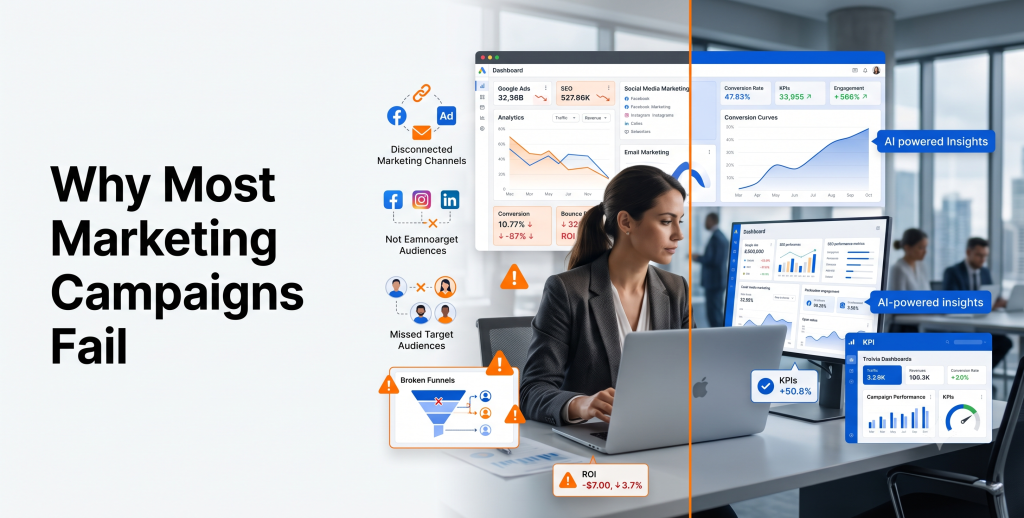
Why Most Marketing Campaigns Fail

A client once told me she’d spent her entire quarterly budget on a campaign that generated exactly four leads. Four. The ads looked polished. The offer seemed solid. On paper, everything should have worked. It didn’t, and it’s not because marketing is unpredictable magic. It’s because most campaigns fail for the same handful of reasons, over and over, regardless of industry or budget size. This article breaks down exactly why most marketing campaigns fail, and more importantly, what separates the campaigns that actually deliver results from the ones that quietly drain budgets. What Makes a Marketing Campaign Successful? Before looking at failure, it helps to define success clearly. A successful marketing campaign does three things: Reaches the right audience with a message that resonates Guides that audience toward a clear, specific action Delivers a measurable return that justifies the spend Notice what’s missing from that list: fancy visuals, viral moments, or clever taglines. Those things help, but they’re not the foundation. Strategy is the foundation. Top Reasons Marketing Campaigns Fail Most campaign failures trace back to a mix of unclear planning, weak execution, and poor follow-through. Let’s go through each one in detail. Lack of Clear Goals “We want more sales” isn’t a goal. It’s a wish. A real goal looks like: “Generate 50 qualified leads for our SaaS trial within 60 days at a cost per lead under $40.” That’s specific, measurable, and time-bound. Without a clear goal, you can’t judge whether a campaign worked. You just feel vaguely good or vaguely disappointed, with no data to back either feeling up. Fix: Set one primary goal per campaign, along with a specific number and timeframe attached to it. Poor Audience Research Marketing to “everyone” means marketing to no one effectively. I’ve seen local service businesses run ads targeting an entire city when their actual customers lived within a five-mile radius of specific neighborhoods. The budget got spread thin across people who were never going to convert. Fix: Build a real customer profile — age range, location, pain points, buying behavior — before writing a single line of ad copy. Weak Value Proposition If your ad doesn’t answer “why should I choose you instead of the next option,” it won’t convert, no matter how much you spend boosting it. A gym that advertises “Join today!” says nothing. A gym that advertises “Lose 10 pounds in 8 weeks with a personal trainer, no long-term contract” gives people a reason to click. Wrong Marketing Channels Not every channel fits every business. A B2B software company chasing leads on Instagram often wastes budget that would perform far better on LinkedIn or through targeted search ads. Business Type Often Strong Channels Often Weak Channels B2B SaaS LinkedIn, Google Ads, Email TikTok, Pinterest Local Service Google Business Profile, Facebook LinkedIn E-commerce Instagram, Facebook Ads, Google Shopping LinkedIn B2B Consulting LinkedIn, Email, Referrals TikTok Poor Landing Pages Driving traffic to a cluttered homepage instead of a focused landing page is one of the most common digital marketing failures I see. A landing page needs one job: convert visitors for one specific offer. Multiple competing calls-to-action confuse people, and confused visitors leave. Weak Content Strategy Publishing content inconsistently, or without any connection to what your audience actually searches for, wastes time and rarely builds momentum. Fix: Build content around real customer questions, then publish consistently rather than in bursts followed by long silence. Ignoring SEO Paid ads stop working the moment you stop paying. SEO keeps working long after the initial effort, which makes ignoring it one of the costliest marketing strategy mistakes a business can make. Even a handful of well-optimized pages targeting specific search terms can outperform months of paid campaigns in long-term value. Poor Ad Targeting Broad targeting feels safer, but it usually burns budget fast. Narrow, intent-based targeting almost always outperforms casting a wide net. Fix: Layer targeting by demographics, interests, and behavior, then refine based on which segments actually convert. Low-Quality Creatives Blurry images, generic stock photos, and copy that reads like a corporate memo all quietly kill conversion rates. People respond to creatives that feel authentic. A short, slightly imperfect video of a real product in use often outperforms a polished but generic studio shot. Lack of Personalization Sending the same message to every lead, regardless of where they are in the buying journey, is a fast way to lose interest. A first-time website visitor and a returning customer who abandoned their cart need completely different messages. No Marketing Automation Manually managing follow-ups doesn’t scale. Without automation, leads slip through the cracks simply because no one remembered to follow up in time. Fix: Set up automated sequences triggered by specific actions, like a form submission or a pricing page visit. Poor Follow-Up Process Studies on sales response times consistently show that faster follow-up significantly increases conversion likelihood. Yet many businesses take days to respond to a new lead. Fix: Aim to make first contact within minutes to hours, not days, especially for high-intent leads. Weak Lead Nurturing Not every lead is ready to buy immediately. Without a nurturing sequence, many simply forget about you and move on to a competitor who stayed in touch. Budget Mismanagement Spending the entire budget upfront, without testing first, is one of the most common advertising mistakes small businesses make. Fix: Start with a smaller test budget, identify what performs, then scale spend into the winning campaigns. No A/B Testing Guessing which headline or image performs better wastes money. Testing removes the guesswork. Even simple tests — one headline against another — often reveal surprising differences in performance that pure intuition would never predict. Ignoring Analytics Running a campaign without checking analytics is like driving with your eyes closed. You might get lucky, but you won’t know why, and you can’t repeat it. Tracking the Wrong KPIs Likes and impressions feel satisfying, but they rarely pay the bills. Focus on metrics tied directly to revenue and lead quality instead. Vanity Metric Better Metric to Track

Lead Generation & Business Growth

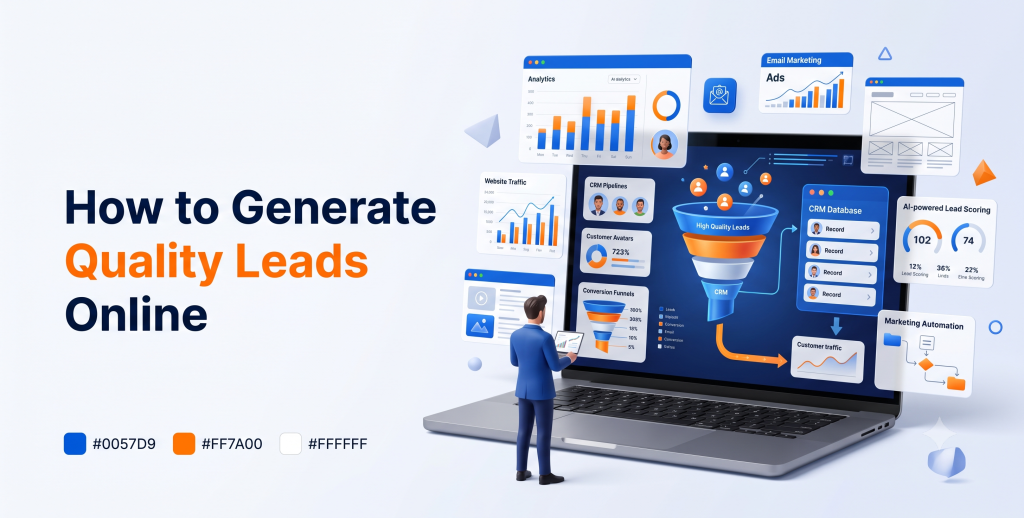
How to Generate Quality Leads Online

Here’s a mistake I see constantly: a business owner gets excited about 500 new website visitors, only to realize a month later that not one of them turned into a paying customer. That’s the trap of chasing numbers instead of quality. Traffic feels good on a dashboard. Leads feel good in your bank account. And quality leads — the ones who actually need what you sell and can afford it — are what keep a business alive. This guide breaks down how to generate quality leads online, step by step, using strategies that work in 2026 and beyond. No fluff, no fabricated promises — just what actually moves the needle. What Are Quality Leads? A quality lead is someone who fits your ideal customer profile, has a genuine need for your product or service, and has the intent or budget to act soon. Compare that to a “leaky bucket” lead: someone who downloaded your free guide out of curiosity, never opens your emails, and never had any intention of buying. Quality leads typically share these traits: They match your target demographic or industry They’ve shown active interest, not just passive curiosity They have the authority or budget to make a purchase decision They’re at the right stage of readiness to consider buying Difference Between Quality Leads and Random Traffic Traffic and leads are not the same thing, even though people mix them up constantly. Random Traffic Quality Leads Visits your site once, never returns Engages repeatedly across channels No clear intent or need Clear problem they want solved Low or no conversion likelihood Reasonable to high conversion likelihood Costs you resources with little return Justifies the marketing spend behind it A blog post that goes viral might bring thousands of visitors overnight. If none of them are your target customer, that traffic spike does almost nothing for revenue. Quality beats quantity, every time. Understanding the Customer Journey Every lead moves through stages before becoming a customer. Skipping steps or rushing the process usually backfires. Awareness — they realize they have a problem Consideration — they research possible solutions Decision — they compare specific providers, including you Purchase — they commit Retention — they stay, and hopefully refer others Your lead generation marketing should meet people where they are in this journey, not push everyone toward a sale on day one. Build an SEO-Optimized Website Your website is often the first real interaction a lead has with your brand. If it loads slowly or confuses visitors, they leave before you ever get a chance to convert them. Website essentials for lead generation Fast loading speed on both desktop and mobile Clear, benefit-driven headlines above the fold Visible calls-to-action on every key page Simple contact and quote request forms Expert tip: Every service page should answer one question — “why should I choose you over the next search result?” If it doesn’t, rewrite it. Content Marketing for Lead Generation Content builds trust before a prospect ever talks to your sales team. Blog posts, guides, and case studies answer questions your leads are already searching for. A SaaS company targeting HR teams might publish “How to Reduce Employee Turnover in 2026.” That single article can attract exactly the right audience, month after month, without ongoing ad spend. Best practice: Match content to funnel stage. Top-of-funnel content should educate. Bottom-of-funnel content, like comparison pages or case studies, should help someone decide. Landing Pages That Convert A generic homepage rarely converts as well as a dedicated landing page built for one specific offer. Lead Magnets A lead magnet trades something valuable for a visitor’s contact information. It only works if the value is real. Effective lead magnet ideas include: Free templates or checklists Short educational webinars Free consultations or audits Industry benchmark reports Avoid generic magnets like “10 Tips for Success.” Specific, practical resources convert far better than vague ones. Email Marketing Funnels Once you capture a lead’s email, the real relationship-building begins. Email marketing funnels nurture leads automatically, moving them from curious to convinced. A simple, effective funnel looks like this: Welcome email introducing your brand and value Educational email solving a small piece of their problem Case study or proof email showing real results Direct offer email with a clear next step Lead nurturing through email consistently produces some of the strongest returns of any digital channel, largely because it’s low-cost and highly targeted. Google Ads Lead Campaigns Google Ads captures people actively searching for solutions, which makes it one of the fastest ways to generate sales leads with clear intent. Pro tip: Use call-only ads for service businesses where phone conversations close deals faster than online forms. Focus on: Tight keyword targeting tied to buying intent Dedicated landing pages, not your homepage Negative keywords to filter out irrelevant clicks Facebook Lead Ads Facebook Lead Ads let prospects submit their information without ever leaving the platform, which reduces friction significantly. This format works especially well for: Local service businesses Webinar or event sign-ups Free trial or demo offers Keep forms short. Every extra field you ask for reduces completion rates. LinkedIn Lead Generation For B2B lead generation, LinkedIn remains one of the most reliable platforms available. Decision-makers are there, and the targeting options let you reach specific job titles and industries directly. Use LinkedIn Lead Gen Forms to reduce drop-off Share genuinely useful posts, not constant self-promotion Engage in relevant industry groups and discussions Organic Social Media Paid ads get attention fast, but organic social media builds long-term trust. Share behind-the-scenes content, client wins, and educational posts consistently. The goal isn’t viral reach. It’s staying visible and credible to the audience most likely to become leads. Video Marketing Video builds trust faster than text alone. Short explainer videos, testimonials, and product demos help prospects understand your value quickly. Even simple, smartphone-recorded videos work well when they’re genuine and answer real customer questions. AI Chatbots AI chatbots can qualify leads instantly, even outside business hours. A well-configured chatbot asks a few smart questions,

Lead Generation & Business Growth

Top Digital Marketing Strategies for Small Businesses

If you run a small business, you already know the rules changed. The customer who used to walk past your storefront now scrolls past your Instagram post instead. And in 2026, that scroll happens fast — you get about three seconds to earn attention before someone swipes away. That’s exactly why digital marketing isn’t optional anymore. It’s the new front door to your business. Whether you sell handmade candles, run a local bakery, or offer consulting services, your customers are searching, comparing, and deciding online before they ever pick up the phone. The good news? You don’t need a massive budget or a marketing degree to compete. You need the right strategies, applied consistently. Let’s walk through what actually works. Why Digital Marketing Matters for Small Businesses Big brands have big budgets. Small businesses have something better: agility and authenticity. Digital marketing levels the playing field. A well-optimized Google Business Profile can put your bakery above a national chain in local search results. A genuine, well-written blog post can outrank a corporate page that spent thousands producing generic content. Here’s what digital marketing gives small businesses that traditional advertising never could: Measurable results — you know exactly what’s working Lower costs compared to print, radio, or TV ads Direct access to your ideal customers, not just anyone who happens to see a billboard The ability to build trust before a customer ever contacts you This is the foundation. Everything else builds on it. Build a Fast and SEO-Friendly Website Your website is your digital storefront. If it’s slow, cluttered, or hard to navigate, people leave — often within seconds. What a good small business website needs Load time under 3 seconds (test this with Google PageSpeed Insights) Mobile-friendly design, since most visitors browse on their phones Clear calls-to-action like “Book a Call” or “Get a Quote” Simple navigation — visitors shouldn’t have to hunt for your services or contact info Pro tip: A local plumber I worked with rebuilt his outdated site with faster load times and clear service pages. His phone inquiries doubled within two months, without spending a dollar more on ads. Invest in Local SEO If you serve customers in a specific area, local SEO deserves serious attention. This is how you show up when someone searches “coffee shop near me” or “electrician in [city].” Local SEO basics that actually move the needle Use your city and neighborhood names naturally in website content Build local citations on directories like Yelp and industry-specific sites Keep your name, address, and phone number consistent everywhere online Earn backlinks from local news sites, chambers of commerce, or community blogs Local business marketing isn’t glamorous work, but it’s often the highest-return activity available to a small business. Google Business Profile Optimization Your Google Business Profile is arguably the single most important free marketing tool you have. Steps to optimize it properly Fill out every section completely — hours, categories, services, and attributes Add fresh photos regularly, not just once at setup Post updates and offers through the profile’s post feature Respond to every review, good or bad Choose accurate primary and secondary business categories A fully optimized profile often outperforms paid ads for local visibility, and it costs nothing but time. Content Marketing Strategy Content marketing builds trust over time. It answers the questions your customers are already typing into Google. Think about what your customers ask you in person. Turn those questions into blog posts, guides, or FAQs. A landscaping company might write “How Often Should You Water Your Lawn in Summer?” That single post can bring in traffic for years. Best practice: Publish consistently rather than perfectly. One solid post a week beats ten posts crammed into a single month, then silence for three. Email Marketing Email marketing remains one of the most affordable digital marketing tips available, with returns that consistently outperform social media. How to use it well Send a welcome email immediately after someone subscribes Share useful tips, not just sales pitches Segment your list so loyal customers get different messages than new leads Keep subject lines short and honest — no clickbait A small skincare brand I know sends one helpful tip per week alongside occasional promotions. Their email list now drives nearly 30% of total sales. Social Media Marketing Social media isn’t about being everywhere. It’s about being consistent where your customers actually spend time. A B2B consultant probably belongs on LinkedIn, not TikTok A boutique clothing store likely thrives on Instagram A local service business often does well with Facebook groups and community pages Post behind-the-scenes content, customer stories, and genuine moments. People connect with people, not polished ads. Google Ads Google Ads puts you in front of people actively searching for what you sell. That intent makes it one of the most efficient forms of paid marketing. Pro tip: Start small. Set a modest daily budget, target specific keywords tied to your services, and track which ads actually convert before scaling up spend. Facebook & Instagram Ads While Google Ads captures intent, Facebook and Instagram ads build awareness and re-engage past visitors. Use retargeting ads to reach people who visited your site but didn’t buy Test multiple images or videos to see what resonates Keep ad copy conversational, not corporate A small furniture shop used retargeting ads showing items customers had browsed. Their conversion rate nearly tripled compared to generic ads shown to cold audiences. Video Marketing Video builds trust faster than almost any other content format. You don’t need expensive equipment — a smartphone and good lighting go a long way. Ideas that work well for small businesses: Quick product demonstrations Customer testimonials Behind-the-scenes footage of your process Short educational clips answering common questions AI-Powered Marketing Automation AI tools have made marketing automation accessible to businesses of any size. You can now automate email sequences, chatbot responses, and even ad optimization without hiring a full marketing team. Use AI to save time on repetitive tasks, but keep your brand’s voice human.

Content Marketing

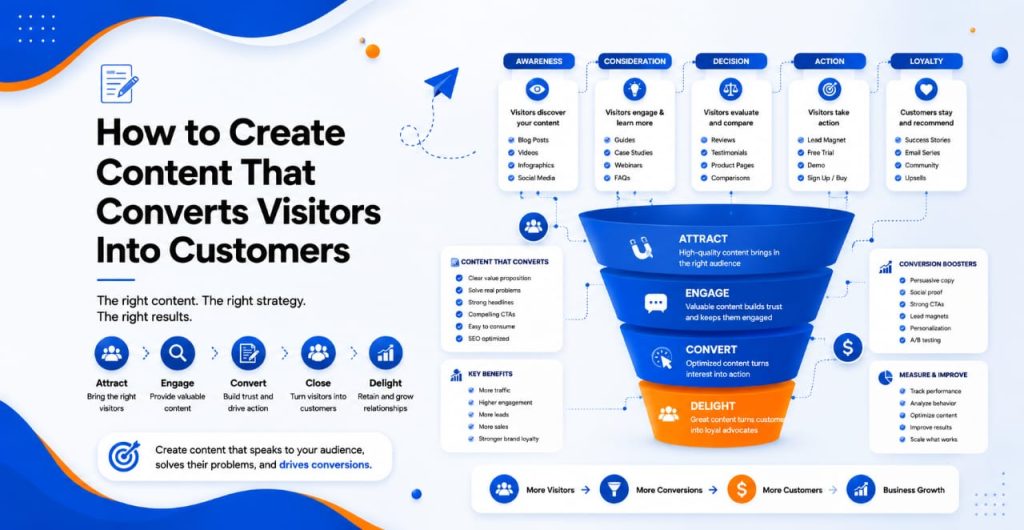
How to Create Content That Converts Visitors Into Customers

Introduction Did you know that most websites convert less than three percent of their visitors into paying customers? Traffic alone will not grow your business. Without strategic, conversion-focused content, even thousands of monthly visitors can leave without taking action. Learning how to create content that converts visitors into customers means understanding your audience, matching their intent, and guiding them confidently through the buyer journey. This guide breaks down exactly how to do that, step by step, with practical examples you can apply immediately What Is Conversion-Focused Content? Conversion-focused content is writing designed with a clear business goal in mind, whether that is a purchase, a signup, or a booked call. Unlike purely informative content, it blends education with persuasion. This distinction matters because informative content builds awareness, while conversion-focused content moves readers toward a decision. Businesses that combine both create a content funnel that nurtures leads from first click to final sale. Content Type Primary Goal Example Informative Content Educate and build awareness Blog post explaining a concept Conversion-Focused Content Drive a specific action Landing page with a clear CTA Trust-Building Content Reduce buyer hesitation Case study or testimonial page How to Create Content That Converts Visitors Into Customers The following ten strategies form a proven content marketing strategy for turning casual browsers into loyal, paying customers. 1. Understand Your Target Audience You cannot convert someone you do not understand. Build clear buyer personas that outline your audience’s goals, pain points, and objections before writing a single word. Example: A SaaS company selling project management software might discover its main users are overwhelmed team leads, not executives, and adjust its messaging accordingly. 2. Match Content to Search Intent Google rewards content that satisfies the intent behind a query, whether that intent is informational, navigational, or transactional. Example: An eCommerce brand ranking for “best running shoes for flat feet” should write a buying guide, not a generic product description. 3. Write Compelling Headlines Your headline determines whether visitors stay or leave. Strong headlines promise a clear benefit and spark curiosity. Example: Changing “Our Services” to “How Our Software Cuts Onboarding Time by 40%” immediately signals value. 4. Focus on Solving Customer Problems Every section of your content should answer a real question or resolve a real frustration your prospect has. Example: A digital agency blog that walks readers through fixing slow page speed builds authority while naturally showcasing expertise. 5. Build Trust with Social Proof and Case Studies Testimonials, reviews, and data-backed case studies reduce the perceived risk of taking action. Example: A startup adding “Trusted by 500+ small businesses” beside a client logo bar often sees stronger form completions. 6. Use Clear and Persuasive Calls-to-Action (CTAs) A strong call-to-action tells visitors exactly what to do next and why it benefits them. Example: Replacing “Submit” with “Get My Free Audit” consistently improves click-through rates. 7. Optimize Content for SEO and Readability Content must be discoverable and easy to scan, with clear headings, short paragraphs, and natural keyword placement. Example: A blog broken into scannable subheadings keeps mobile readers engaged far longer than dense text blocks. 8. Use Visuals to Improve Engagement Images, charts, and short videos break up text and help explain complex ideas quickly. Example: A comparison chart on a pricing page often reduces support questions and speeds up decisions. 9. Create High-Converting Landing Pages Landing pages should have one focused goal, minimal distractions, and a benefit-driven headline supported by proof. Example: Removing extra navigation links from a signup page can meaningfully increase completed registrations. 10. Measure, Test, and Improve Performance Conversion optimization is ongoing. Use analytics and A/B testing to refine headlines, CTAs, and layouts over time. Example: A marketing team testing two CTA colors might find one variant consistently outperforms the other. Common Mistakes That Reduce Content Conversions Writing only for search engines instead of real readers Weak or missing calls-to-action Ignoring user intent behind key search terms Poor website navigation that hides next steps Long, unreadable paragraphs that overwhelm visitors Lack of trust signals like reviews or case studies No performance tracking to guide improvements Best Tools for Creating High-Converting Content The right tools make it easier to research, write, and optimize content that performs. Tool Purpose Best For Google Analytics Tracks visitor behavior and conversion paths Measuring which content drives sales Google Search Console Monitors search performance and indexing Improving organic visibility Ahrefs Keyword research and backlink analysis Competitive SEO strategy SEMrush All-in-one SEO and content auditing Content gap analysis Grammarly Grammar and readability checking Polishing conversion copy Canva Visual and graphic design Creating engaging visuals Hotjar Heatmaps and session recordings Understanding user behavior HubSpot CRM and marketing automation Managing leads and CTAs Best Practices for Conversion-Focused Content Marketing Know your audience deeply before writing Prioritize user experience across every page Write benefit-driven copy, not just features Use strong, specific CTAs throughout your funnel Add testimonials and reviews for social proof Optimize every page for mobile devices Improve page speed to reduce bounce rate Update content regularly to stay accurate and ranked A/B test headlines and CTAs to find what works Key Takeaways Traffic without conversion-focused content rarely turns into revenue. Understanding audience intent is the foundation of high-converting content. Strong headlines and CTAs directly influence conversion rate optimization. Social proof reduces hesitation and builds buyer confidence. SEO and readability work together to keep visitors engaged. Landing pages should have one clear, focused goal. Continuous testing and measurement drive long-term improvement. Conclusion Learning how to create content that converts visitors into customers is not about tricks or shortcuts. It is about combining SEO, genuine value, trust-building, and compelling CTAs into a seamless customer journey. When every page on your site is built with the reader’s needs and your business goals in mind, visitors naturally become customers, and customers become long-term advocates for your brand. Take a moment to audit your existing content today. Identify weak CTAs, outdated pages, and missed opportunities, then start optimizing for conversions one page at a time. Frequently Asked Questions (FAQ)

Content Marketing

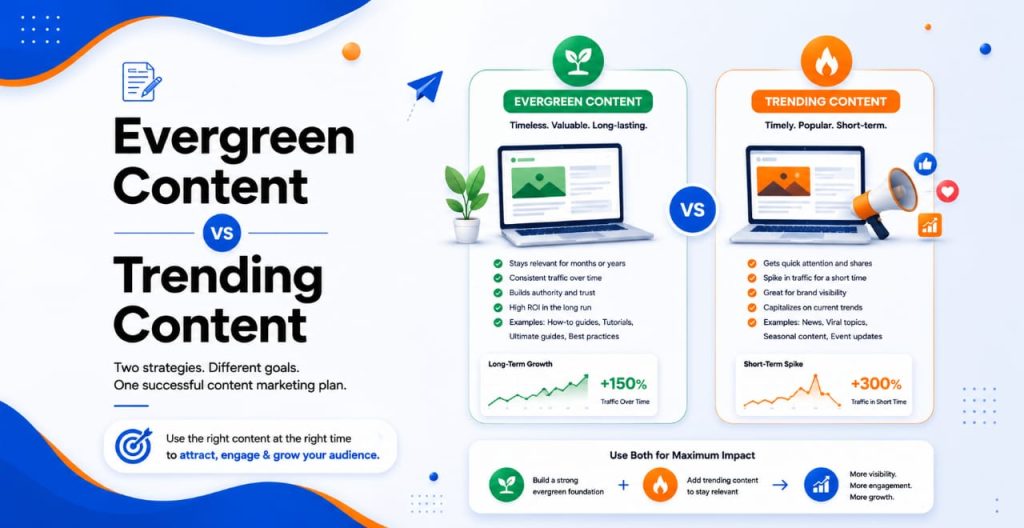
Evergreen Content vs Trending Content: Which Wins?

Introduction Should your next blog post chase this week’s headlines, or answer a question people will still be asking in five years? Most businesses never consciously choose. They just publish whatever feels urgent, then wonder why traffic is unpredictable. Evergreen content stays relevant for years, while trending content capitalizes on what is popular right now. Understanding evergreen content vs trending content is essential for long-term marketing success, since each type plays a different role in your traffic and revenue. This guide breaks down both types, compares them directly, and shows you how to balance them in one strategy. What Is Evergreen Content? Evergreen content is material that stays useful and accurate long after publication, without needing constant rewrites. It typically answers timeless questions rather than covering current events. Key characteristics include stable search demand, minimal maintenance, and a focus on foundational topics. For SEO, evergreen content is powerful because it keeps earning organic traffic and backlinks for years, compounding in value the longer it stays online. Common examples include: How-to guides and tutorials Glossaries and definition pages Beginner’s guides to a topic Case studies with lasting lessons What Is Trending Content? Trending content covers what is happening right now, from breaking news to viral topics. It is built for immediate relevance rather than lasting value. Its key characteristics are a short shelf life, high timeliness, and a strong connection to current conversations. The benefit is speed: trending content can drive a fast spike in traffic, social shares, and engagement while interest is at its peak. Common examples include: Reactions to industry news Product launch announcements Seasonal or holiday campaigns Posts riding a viral social trend Evergreen Content vs Trending Content Choosing between the two depends on your goals. Evergreen content builds a durable traffic base, while trending content creates short bursts of visibility. Feature Evergreen Content Trending Content Lifespan Years, with occasional updates Days to a few weeks SEO value Strong, compounds over time Minimal long-term SEO impact Traffic potential Slow, steady growth Fast initial spike, then decline Audience engagement Steady, ongoing interest High but short-lived Content maintenance Periodic updates needed Little to no maintenance Lead generation Consistent, compounding leads Short bursts of leads Marketing ROI High over the long term High but short-term only Ideal use case Guides, tutorials, resources News, launches, seasonal events Advantages and Disadvantages Evergreen Content Pros: consistent traffic, strong long-term SEO value, and content that keeps generating leads with no extra spend. Cons: slower initial results, and posts still need occasional updates to stay accurate. Trending Content Pros: fast traffic spikes, strong social shares, and quick opportunities to join relevant conversations. Cons: short lifespan, and content that can become irrelevant or even embarrassing once the trend fades. When Should Businesses Use Evergreen Content? Evergreen content works best as the foundation of most content strategies: Service businesses: how-to guides that answer common customer questions E-commerce: buying guides and product comparison pages B2B companies: definitive guides that support the full buyer journey Bloggers: cornerstone posts that anchor a niche and attract backlinks SaaS businesses: tutorials that reduce support tickets and build authority When Should Businesses Use Trending Content? Trending content earns its place when timing matters more than longevity: Reacting quickly to industry news relevant to your audience Announcing product launches while attention is highest Running seasonal campaigns tied to holidays or events Joining viral topics that naturally fit your brand voice Riding social media trends for a short engagement boost How to Balance Evergreen and Trending Content in Your Strategy The strongest content marketing strategy rarely chooses one type exclusively. Instead, it blends both with intention: Build a content calendar with a majority of evergreen posts and scheduled trend-based pieces Maintain an evergreen content library as your traffic and lead generation backbone Leverage trends quickly, but only when they genuinely fit your niche Update evergreen posts every six to twelve months to protect rankings Repurpose both content types across email, social, and video for wider reach Best Tools for Content Research and Planning Tool Purpose Best For Google Trends Tracks rising search interest over time Spotting trending topics early Google Analytics Measures traffic and content performance Comparing evergreen vs trending results Google Search Console Monitors rankings and indexing Tracking long-term evergreen SEO value Ahrefs Keyword and backlink research Finding evergreen topics with lasting demand SEMrush SEO audits and content gap analysis Planning a balanced content calendar BuzzSumo Finds trending and high-sharing content Identifying timely, shareable topics Canva Designs graphics and visuals Producing content for both content types Trello Organizes content calendars and tasks Managing evergreen and trending workflows Best Practices for a Successful Content Strategy Understand audience intent before choosing a topic Perform keyword research to confirm real search demand Combine evergreen and trending topics in your calendar Optimize every post for SEO from the first draft Add internal links to connect related content Update content regularly to keep it accurate Measure performance to see what actually drives results Improve underperforming content based on analytics, not guesses Key Takeaways Choosing between the two is not an either-or decision for most businesses. Evergreen content builds lasting SEO value and predictable organic traffic. Trending content delivers fast visibility and short-term engagement spikes. Service, e-commerce, B2B, and SaaS businesses all benefit from an evergreen foundation. Trending content works best for news, launches, and seasonal campaigns. A content calendar that blends both types produces the strongest marketing ROI. Regular updates keep evergreen posts accurate and competitive over time. Conclusion Evergreen content vs trending content is not really a competition; it is a balance every business needs to strike. Evergreen posts build the steady traffic and authority that sustain your business, while trending content adds timely bursts of visibility on top of that foundation. Review your current content strategy this week. Identify where you are missing an evergreen backbone or a timely trend, and build a balanced content mix that drives sustainable traffic, leads, and revenue. Frequently Asked Questions What is evergreen content? Evergreen content is material that stays relevant

Content Marketing

The Complete Content Marketing Funnel Explained

Introduction Why do most website visitors leave without ever becoming customers? In most cases, it is not the product that fails to convince them. It is the absence of a clear path guiding them from curiosity to purchase. A content marketing funnel solves this problem by mapping content to each stage of the buyer journey. Every business that publishes content, whether a blog, a newsletter, or social posts, needs one to turn casual readers into paying customers. This guide offers the complete content marketing funnel explained, covering every stage, practical strategies, and the tools that make it work. What Is a Content Marketing Funnel? A content marketing funnel is a structured system of content designed to move prospects from first discovering your brand to becoming loyal customers. Unlike a sales funnel, which focuses on transactions and deals, a content funnel focuses on education, trust, and relationship building that eventually leads to a sale. This distinction matters in modern digital marketing because buyers now research extensively before ever talking to a salesperson. A well-built content funnel meets them at each step with the right information. The benefits are significant: Higher-quality leads who already understand your value Shorter sales cycles thanks to pre-built trust More consistent, predictable lead generation Content that keeps working long after publication The Complete Content Marketing Funnel Explained Every funnel breaks down into three core stages, often referred to as TOFU, MOFU, and BOFU. Top of the Funnel (TOFU) – Awareness At this stage, the goal is simply to get discovered by people who have a problem but do not yet know your brand. Their mindset is exploratory; they are searching for information, not a purchase. Blog posts, infographics, and short videos work best here, since they answer broad questions without pushing a sale. SEO optimization plays a critical role, as most TOFU traffic arrives through organic search. A skincare brand publishing “how to build a morning skincare routine” is a classic TOFU example. Middle of the Funnel (MOFU) – Consideration Here, prospects know they have a problem and are actively comparing solutions. Lead nurturing becomes essential, since these readers are close to deciding but not quite ready to buy. Webinars, comparison guides, and email courses perform well at this stage. A project management tool offering a free guide comparing methodologies, gated behind an email signup, turns MOFU interest into a nurtured lead. Bottom of the Funnel (BOFU) – Conversion At the bottom, prospects are ready to decide and just need a final push. The decision-making process centers on proof: pricing, guarantees, and evidence that your solution works. Case studies, free trials, and demo requests are the best content types here, paired with direct calls-to-action like “Start Your Free Trial.” A software company offering a 14-day free trial at the end of a case study captures BOFU-ready leads effectively. How to Create Content for Every Funnel Stage Building a funnel that converts takes deliberate planning, not just publishing at random: Research your audience to understand their questions at each stage Perform keyword research to find terms with real search volume Match content to search intent so readers find what they expect Plan content around a calendar that covers all three funnel stages Use internal linking to guide readers from TOFU posts toward MOFU offers Distribute content across blogs, social media, and email Build email marketing workflows that nurture leads automatically Use retargeting ads to bring MOFU visitors back for a final decision Best Content Types for Each Funnel Stage Funnel Stage Goal Best Content Types CTA TOFU Build awareness Blog posts, infographics, short videos “Learn More” MOFU Nurture consideration Webinars, comparison guides, email courses “Get the Guide” BOFU Drive conversion Case studies, free trials, demo requests “Start Free Trial” Common Content Marketing Funnel Mistakes Ignoring audience intent and publishing content nobody searches for Publishing random topics with no connection to the funnel Using weak or generic CTAs that give readers no clear next step Skipping lead magnets, leaving MOFU visitors with no way to convert Neglecting SEO, which limits organic reach at the awareness stage Failing to track performance, so weak content never gets fixed Not nurturing leads after they enter the funnel, letting interest fade Best Tools for Managing a Content Marketing Funnel Tool Purpose Best For Google Analytics Tracks traffic and funnel behavior Measuring stage-by-stage performance Google Search Console Monitors search rankings and indexing Improving TOFU organic visibility HubSpot Manages content, CRM, and workflows Connecting the full funnel end to end Ahrefs Keyword and competitor research Planning content around search intent SEMrush SEO audits and content gap analysis Finding funnel content opportunities Canva Designs graphics and visuals Producing TOFU and MOFU visual content Mailchimp Sends and automates email campaigns Building MOFU nurture sequences Trello Organizes content calendars and tasks Planning content across funnel stages Best Practices for Building a High-Converting Content Marketing Funnel Understand your audience before creating a single piece of content Create content for every stage, not just the top of the funnel Use SEO strategically to attract the right visitors at each stage Offer lead magnets that match what MOFU readers are considering Build email workflows that nurture leads automatically over time Optimize CTAs so every page has one clear, specific next step Measure conversions at each stage to find where prospects drop off Update content regularly to keep it accurate and competitive Key Takeaways Understanding the full funnel shows how content guides buyers from awareness to purchase. TOFU, MOFU, and BOFU each require distinct goals, formats, and CTAs. SEO optimization drives the awareness stage, while nurturing drives consideration. Lead magnets and email marketing convert MOFU interest into sales-ready leads. Case studies and free trials give BOFU prospects the final push they need. Tracking performance at every stage reveals where the funnel needs improvement. A content funnel outperforms random publishing because every piece has a purpose Conclusion The complete content marketing funnel explained in this guide comes down to one core idea: content should meet buyers exactly where they are. Consistent, stage-specific

Content Marketing

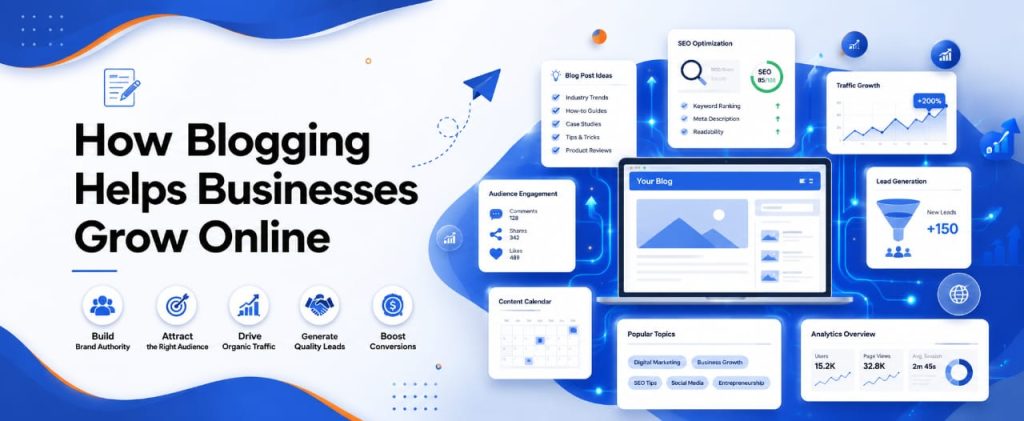
How Blogging Helps Businesses Grow Online

Introduction Do you know that companies with an active blog generate far more website visits than those without one? Yet many business owners still treat their website as a static brochure and wonder why traffic never grows. Most businesses struggle to grow online simply because they stop creating content. Without fresh, relevant pages, search engines have little reason to send new visitors your way. This article explains how blogging helps businesses grow online, and why it remains one of the most effective long-term digital marketing strategies available today. How Blogging Helps Businesses Grow Online Blogging sits at the center of a strong digital marketing strategy because it gives search engines new pages to index and new keywords to rank. Every blog post is another door through which potential customers can find you. Blogs also build trust and authority. When you consistently answer your audience’s questions, readers see your brand as a reliable expert rather than just another company trying to sell something. Over time, this trust compounds, turning one-time visitors into loyal customers and delivering marketing value that outlasts any single ad campaign. 8 Ways Business Blogging Drives Growth 1. Increases Organic Website Traffic Every published post is a new chance to appear in search results and attract organic traffic, without paying for ads. More indexed pages mean more ways for your audience to discover you. Publish consistently around topics your customers actually search for. A local bakery that blogs about seasonal recipes can attract steady search traffic from home bakers well beyond its area. 2. Improves SEO Rankings Search engines reward sites that publish fresh, well-structured content. SEO blogging signals that your site is active and worth crawling regularly. Use keyword research to guide topics, then optimize titles and headings. A software company targeting “project management tips” can climb rankings by publishing guides around that exact phrase. 3. Builds Brand Authority and Credibility Detailed, well-researched posts position your business as a knowledgeable voice in your industry, making prospects more comfortable choosing you over competitors. Write comprehensive guides that go deeper than surface-level advice. A financial advisor who publishes thorough retirement planning articles builds far more credibility than one with no online content. 4. Generates High-Quality Leads Blog posts that address specific customer problems attract readers who are already interested in your solution, making blogging one of the most efficient lead generation channels available. Pair each post with a relevant offer, such as a checklist or free consultation. A marketing agency blogging about social media trends can capture leads with a related audit at the end of the post. 5. Supports Content Marketing Strategy Blog posts feed a broader content marketing strategy, powering email newsletters, social posts, and sales materials. One strong article can fuel weeks of additional content. Plan blog topics around your overall marketing calendar rather than in isolation. An e-commerce brand can turn a single post into a product launch story across every channel it uses. 6. Improves Customer Engagement Blogs give customers a reason to return to your site beyond making a purchase. Comments, shares, and repeat visits all deepen customer engagement over time. Encourage discussion by ending posts with a question. A fitness studio that blogs about workout tips often sees members commenting and sharing their own progress. 7. Provides Valuable Content for Social Media and Email Marketing A single blog post can be repurposed into several social captions, an email newsletter, and even short video scripts, keeping every channel active without extra work. Break long posts into smaller snippets for different platforms. A consultant who publishes one post weekly can fill an entire month of email marketing and social content from that material alone. 8. Delivers Long-Term Marketing ROI Unlike paid ads that stop working once the budget runs out, blog posts keep attracting visitors for months or years after publishing, making blogging one of the strongest sources of long-term marketing ROI. Focus on evergreen topics that stay relevant over time. A home improvement company that publishes a guide on choosing flooring materials can keep earning traffic and leads long after the post goes live. Common Blogging Mistakes Businesses Should Avoid Publishing inconsistently, which stalls momentum with both readers and search engines. Ignoring SEO best practices, leaving well-written posts undiscoverable. Writing only promotional content instead of genuinely helpful information. Not understanding audience intent, so posts fail to answer what readers actually searched for. Using weak or missing CTAs, leaving readers with no clear next step. Failing to update older blog posts, letting once-strong rankings quietly decline. Best Tools for Business Blogging Tool Purpose Best For Google Analytics Tracks website traffic and visitor behavior Measuring blog performance and conversions Google Search Console Monitors search rankings and indexing health Fixing SEO issues and tracking keywords Ahrefs Keyword research and backlink analysis Planning topics with real search demand SEMrush Competitor research and SEO audits Agencies and teams managing multiple blogs Grammarly Checks grammar, clarity, and tone Polishing drafts before publishing Canva Designs blog graphics and social visuals Creating images without a design team WordPress Hosts and publishes blog content Building and managing the blog itself HubSpot Manages content, CRM, and lead tracking Connecting blogging to sales and marketing Best Practices for Creating Successful Business Blogs Understand your audience and write directly to their needs. Perform keyword research before drafting any post. Write engaging, specific headlines that promise a clear benefit. Use internal and external links to add context and credibility. Add visuals to break up text and illustrate key points. Optimize images with descriptive file names and alt text. Include clear CTAs that guide readers toward the next step. Update existing content regularly to protect rankings and accuracy. Key Takeaways Consistent, valuable content is what drives real online business growth through blogging. Blogging improves SEO rankings and drives organic traffic without ongoing ad spend. Well-researched posts build brand authority and customer trust over time. Blogging supports lead generation and feeds a broader content marketing strategy. Repurposed blog content strengthens social media and email marketing efforts. Avoiding

Content Marketing

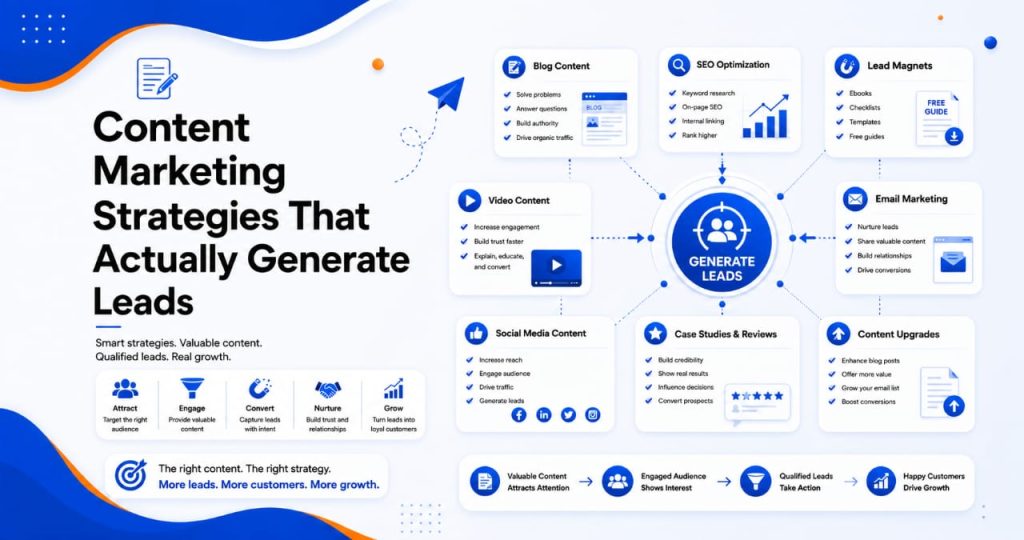
8 Content Marketing Strategies That Actually Generate Leads

Introduction Are you publishing blog posts every week but still waiting for leads to show up in your inbox? You are not alone. Many small business owners and marketing managers pour hours into content creation, only to watch traffic rise while sales conversations stay flat. The problem is rarely a lack of effort. It is usually a lack of strategy. Content marketing works only when every post, email, and social update is built around a clear path to conversion. In this article, you will learn why content marketing matters for lead generation, eight proven content marketing strategies you can apply right away, common mistakes that kill results, and tools that make execution easier. Why Content Marketing Matters for Lead Generation Valuable content builds trust before a prospect ever speaks with your sales team. When you answer real questions, readers start to see your brand as a credible source rather than just another vendor. That trust turns a stranger into a subscriber, and eventually into a customer. Content also nurtures prospects through every stage of the buying journey. A blog post might attract someone researching a problem, a case study can convince them your solution works, and a well-timed email can push them toward a decision. Without this connected content funnel, most visitors leave your site and never return. 8 Content Marketing Strategies That Actually Generate Leads 1. Know Your Target Audience You cannot create content that converts if you do not know who you are writing for. Build buyer personas that cover your audience’s goals, challenges, and the language they use when searching for solutions. Interview current customers and review support tickets for recurring questions. A SaaS company targeting startup founders might discover their audience cares more about implementation speed than price, which should shape every headline and CTA. 2. Create SEO-Optimized Blog Content SEO content brings in visitors who are already searching for what you offer, which makes them more likely to convert than cold traffic. Focus on keyword research, clear headings, and content that answers the searcher’s intent. Find low-competition keywords with real buyer intent, then structure posts with descriptive H2 and H3 headings. A local accounting firm that publishes a guide on small business tax deductions can rank for searches from owners actively looking for help. 3. Offer High-Value Lead Magnets A lead magnet trades something useful, like a checklist, template, or mini-course, for a visitor’s contact information. This works because it gives people a reason to share their email beyond simply liking your blog. Keep the offer specific and tied to the page it appears on. A marketing agency offering a “30-Day Social Media Content Calendar” on a social media post will convert better than a vague “free guide” popup. 4. Build an Email Nurture Funnel Most visitors are not ready to buy the first time they find your content, so an email nurture funnel keeps the conversation going. Helpful, well-timed emails build familiarity and move subscribers closer to a decision. Map out five to seven emails mixing education, social proof, and a clear offer near the end. An online course creator might send a welcome email, two lessons, a testimonial, and a discount code to encourage enrollment. 5. Repurpose Content Across Multiple Platforms Turning one blog post into several formats multiplies your reach without multiplying your workload. This content distribution approach also meets your audience where they already spend time. Turn a long post into a LinkedIn carousel, a short video script, and social media marketing snippets. A B2B consultant who repurposes one article into five LinkedIn posts often generates more inquiries than the original post alone. 6. Publish Case Studies and Customer Success Stories Case studies work because they show real proof instead of promises, which is what skeptical buyers want before committing. They translate features into outcomes a prospect can picture for their own business. Structure each story around the customer’s problem, your solution, and measurable results. A software company that publishes a case study showing a client cut onboarding time by 40 percent gives sales reps a powerful tool to share with leads. 7. Use Strong Calls-to-Action (CTAs) A CTA tells the reader exactly what to do next, and without one, even great content leads nowhere. Vague phrases like “learn more” rarely perform as well as CTAs tied to a specific benefit. Test action-oriented language such as “Get Your Free Marketing Audit” instead of “Submit.” An e-commerce brand that changed its CTA from “Subscribe” to “Get 15% Off” saw a noticeable lift in signups. 8. Track Performance and Optimize Regularly You cannot improve what you do not measure, so tracking performance protects your marketing ROI. Regular analysis shows which content actually drives leads and which pieces need reworking. Review traffic, conversion rates, and keyword rankings monthly, then double down on what works. A marketing manager who notices one post driving most demo requests can create similar content around that topic. Common Content Marketing Mistakes That Reduce Lead Generation Publishing Inconsistent Content Sporadic publishing makes it hard to build momentum with search engines or your audience. A realistic, consistent schedule beats an ambitious one you cannot maintain. Ignoring SEO Great writing without SEO content fundamentals means fewer people ever find it. Keyword research and on-page optimization should happen before you write, not after. Weak CTAs Content without a clear next step leaves readers to figure it out themselves, and most will simply leave. Every page needs a specific, benefit-driven action. Creating Content Without Understanding User Intent Ranking for a keyword means little if the content does not match what searchers want. Always ask what problem the reader is trying to solve before writing. Not Measuring Performance Skipping analytics means repeating the same mistakes. Set up tracking from day one so every piece of content can prove its worth. Recommended Tools Tool Purpose Best For Google Analytics Tracks website traffic and user behavior Measuring content performance and marketing ROI Google Search Console Monitors search rankings and indexing issues Improving SEO content and fixing

Scroll to Top